Once a pun a time, or why you shouldn’t judge me

Standard

Samuel Johnson frowning at Shakespeare's puns (courtesy of Wikipedia)


Samuel Johnson called punning the lowest sense of humor. I would take offense but the man is dead, and he wouldn’t care. When he wasn’t speaking ill of puns, Johnson collected words to put in his little dictionary of the English language, frowned through all of Shakespeare’s plays because they are full of puns and then annotated them out of spite, got grouchy and criticized literature (in a scholarly way), and tossed off poems, essays, and biographies before breakfast.


So, yes, we have a lot in common. But, we do not share the same opinion about puns. I think of them as the dark chocolate of humor; good any time of the day, at or between meals, with coffee or wine, with or without nuts, and in all forms.

Well known pharmaceutical company (photo by gabrielsaldana at http://www.flickr.com/photos/gabrielsaldana/5704626269/


I know what you’re thinking. No, friend, I am not addicted to chocolate. I use it purely for medicinal purposes. First, chocolate is good for the heart. I have loved chocolate since before I remember, and that’s how long my heart has been beating. If I stop eating chocolate, my heart may stop. I can’t risk that. Second, chocolate is good for the brain. You have only to read this blog to see the effects of lots of dark chocolate on my brain. Impressive, no? (Note: some questions on this blog are for rhetorical purposes only and in no way imply that you need to answer.)


As for the compulsive punning, I have spoken of it once before, and it is a kind of brain disorder called Foerster’s Syndrome that I self-diagnosed years ago. I have been self-diagnosing for years and have experienced multiple medical miracles along with bouts of alliteration in which I have been healed of life-threatening diseases of the nervous system, the digestive system, and for a short time, the bubonic plague, all without any medical intervention whatsoever. My baffled doctors attributed my symptoms to indigestion and the common cold. As if. No doubt there’s a connection between their bafflement and lack of chocolate.


All I’m asking for is a little compassion, friend, if and when I publish a post full of puns, even if it’s tomorrow.

The noble peasant

Standard

Peasant blood flows through me. I like simple food, simple clothes, and a simple home. Even my mind is simple. I am a plodder and a hard worker – show me the broom, hand me the rag, and I will get to work and make it shine. Get me started; I will finish.


That is fancy talk for: I am a neurotic. I feel compelled to finish what I start, no matter how unpleasant it is, and I’ve convinced myself that there is something noble about doing so.


I also must take anything that is free. Two packets of artificial sugar are served with my coffee? I must take them home. Do I use artificial sugar? No. Have I ever used it? No. Does anyone in my family use it? (Note to self: Please stop asking questions you know the answer to.) But you never know, smarty-pants self. Occasionally, someone visits, asks for some, and I win.


When we travel I must take the toiletries placed in my room. If I don’t, the hotel will buy fewer products, which leads to a lower demand for products, fewer jobs, higher unemployment, and societal breakdown. So I do it for your sake, friend. I am noble that way.


Proof of how I am saving the economy. You're welcome.


I also ask others for their free toiletries, so I have bags of stuff. A number of years ago, I reached into one of those bags and pulled out a small, silver tube of toothpaste. I put all of it on my toothbrush and nearly gagged when I started brushing. Ack, I thought, this is disgusting. I continued brushing, gagging and sputtering the entire time, but finally completed the task I started out to do. After rinsing my mouth several times to get the taste out of my mouth, I looked at the little tube more closely. In tiny letters, it read: Shaving Cream.


Yes, I carefully brushed all of my teeth with shaving cream, starting at the back with my molars, working in a clockwise direction on each tooth, brushing both sides, and remembering to brush the tops of my molars. Did I brush my tongue? Probably. My neurosis goes to the dentist with me, so it knows the drill. (Gag alert: gratuitous pun.)


For a sparkling shave, I suggest Crest; for stubble-free teeth, my choice is Barbasol


If this neurosis had a blog, the comment section would be closed. So I’ve learned to live with it and call it being frugal or noble, but if you  read the fine print, you’ll see what it really is.

Warning: someone may be monkeying with you

Standard

A while back I wrote about a quotation on my post-post-publication page by Truman Capote, “That’s not writing at all, that’s typing.” He said that about Jack Kerouac’s book On the Road, and he meant it as a slur.

Apparently this quote has appeared on other blogger’s pages as well, one of many randomly generated quotations about writing. So, it wasn’t meant personally.

However, no slight, real or imagined, is too small for me to take notice of, worry about, mope about, or whine about. It’s what I do.

And then, I had an epiphany, which sounds like a medical procedure, but isn’t. (I’ll tell you, Gertie, I don’t know why I waited so long to have that epiphany. I can see so much better now. It didn’t hurt a bit.)

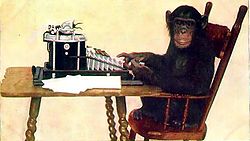
Yearstricken hitting random keys for her blog (picture courtesy of Wikipedia)

Without knowing it, Capote was rephrasing the Infinite Monkey Theorem, which states that “a monkey hitting keys at random on a typewriter keyboard for an infinite amount of time will almost surely type a given text, such as the complete works of William Shakespeare.”

When I read that, I suddenly knew what light through yonder window breaks. And it isn’t Juliet, Romeo. It is the light from the computer screen of the Infinite Monkey. Let me break it down for you:

  • I hit keys at random on my computer every day.
  • I spend an infinite amount of time hitting those keys.
  • I like bananas.

Forsooth, I may have to change the name of my blog to Infinite Monkey. And you might, too, although it would be confusing if we all used that name. My point is that there are probably millions of us hitting random keys all day long.

According to my imagination, it’s highly probable that WordPress is run by a bunch of scientists who are testing out the Infinite Monkey Theorem. It’s not for nothing that your year-end statistics were brought to you by monkeys, right?

After you get over your alarm, I hope this encourages you. The next time someone reads some of your stuff and says, “Well, it ain’t Shakespeare,” you can answer, “Not yet, friend, not yet, but one of these days.”

The tall dark stranger

Standard

Elmer (mother’s father), Ketz (her first husband), Clyde (her first son)

Mother was a monogamist four times. At least, I think she was. Pregnant at 15, she had her first child at 16. Before she gave birth to Connie, her first little green-eyed girl, she married the child’s father. Ketz was older than her and had charmed her with his good looks. It’s unclear if he was really her husband. Another wife lived somewhere in his past, and he may or may not have been legally divorced from her. Two years later, mother’s second child, Clyde, was born; a green-eyed boy with curly hair, who looked like his daddy.

Whether the first marriage was monogamy or bigamy, it didn’t last long. Ketz never wanted to put his hard-earned money into the hands of landlords and utility companies; he preferred investing in gambling and other women. Mother had nothing to give the bill collectors, so she left Ketz and moved back in with her mother.

Connie, the oldest girl, and Clyde, the oldest son

One year after  Clyde was born, Germany invaded Poland and World War II officially started. That year, 1939, President Roosevelt proclaimed U.S. neutrality, but just in case, he also asked for a $1.3 million defense budget.

The build up of the armed forces, along with increased federal spending, helped pull the U.S. out of the Great Depression, but unemployment was still high in the area of Pennsylvania mother lived in. So, she left the two children with her mother and went to New York to find work. Finally free from feeding, diapering, and caring for two small children, she went wild, dancing and drinking every night, and waking up on one particular morning with a tattoo of her name on her shoulder.

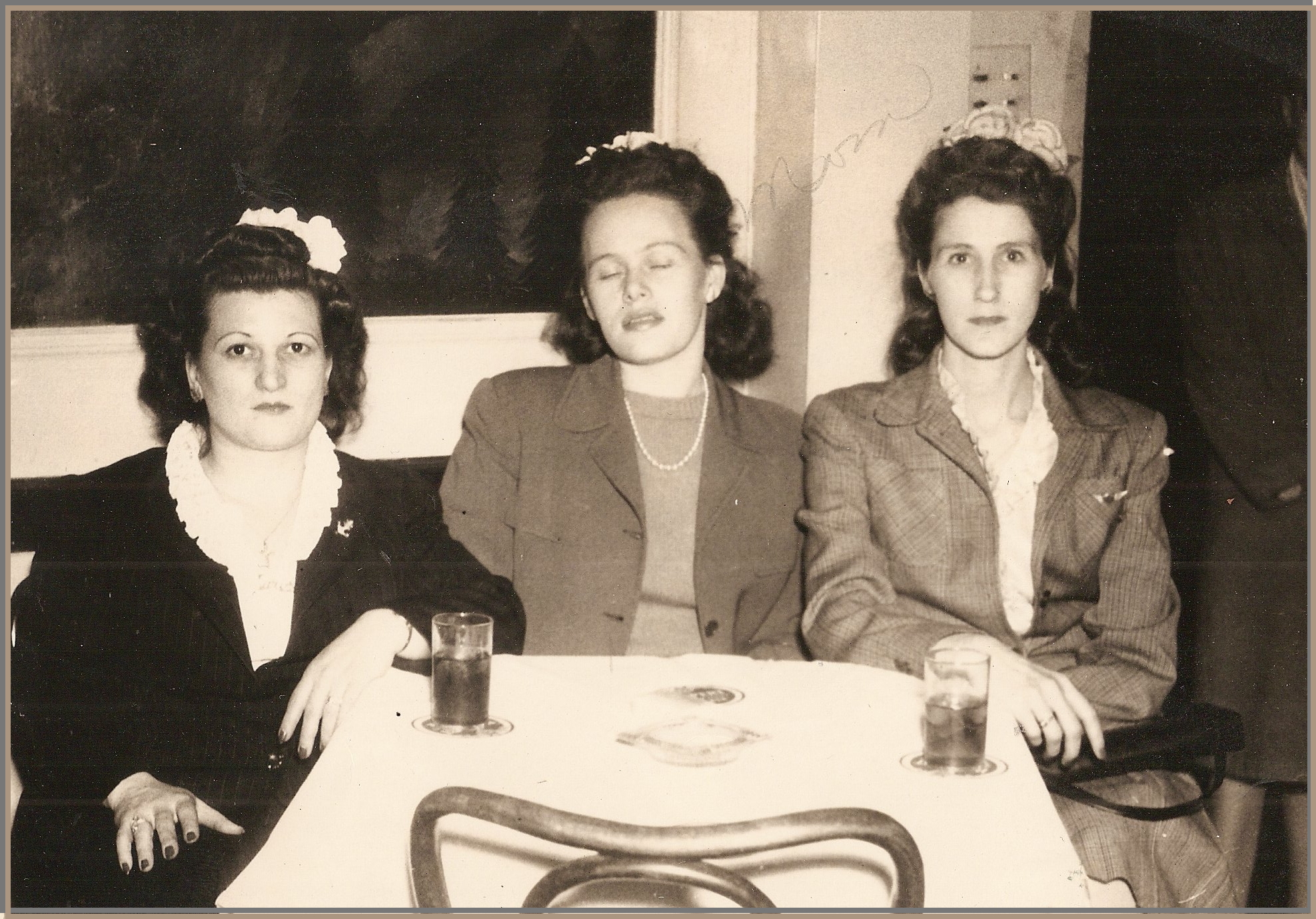
Mother (in the middle) at a nightclub in New York

One of the nights she went out drinking and dancing, she met Grady, a handsome officer in the Merchant Marines. They did more than just drink and dance together, and she got pregnant with her third child. Right about that time, Japan dropped its bombs on Pearl Harbor and the U.S. officially declared war. Grady shipped out, telling mother he didn’t know when he would be back. Late in her pregnancy when she could no longer work, her friends took her in. Her father, Elmer, died right after she gave birth to James, so she returned once more to her mother’s house, with another baby.

Jobs were hard to find in Barnesboro, so she left the three children with her mother and went to Chester to find a waitressing job. World War II brought manufacturing and ship building jobs to Chester, which sits on the Delaware River across from southwestern New Jersey. Once she found a job and got an apartment, her mother and the three children joined her. Not long after that, Grady showed up again and they decided to get married.

Mother’s darkest days were just ahead of her, but of course, she didn’t know that. You never do. The future, a tall dark stranger with good looks and an easy laugh, holds out his hand and you take it. In some stories he carries you off into the sunset and you live happily ever after. In other stories, he takes you home, beats the life out of you, and then leaves you out on the street with five children. And that’s exactly what mother’s future did.

Breaking news! The Mitten War

Standard

From the outside, underneath all those layers of winter clothing, your typical Wisconsinite looks kind, self-effacing, and a just a little fluffy. (It’s the down jacket. Really.) But unzip that jacket, take off the sweater, remove the long johns, call in a surgeon to open the chest cavity, and you will find a heart much like your own, a heart filled with mitten envy.

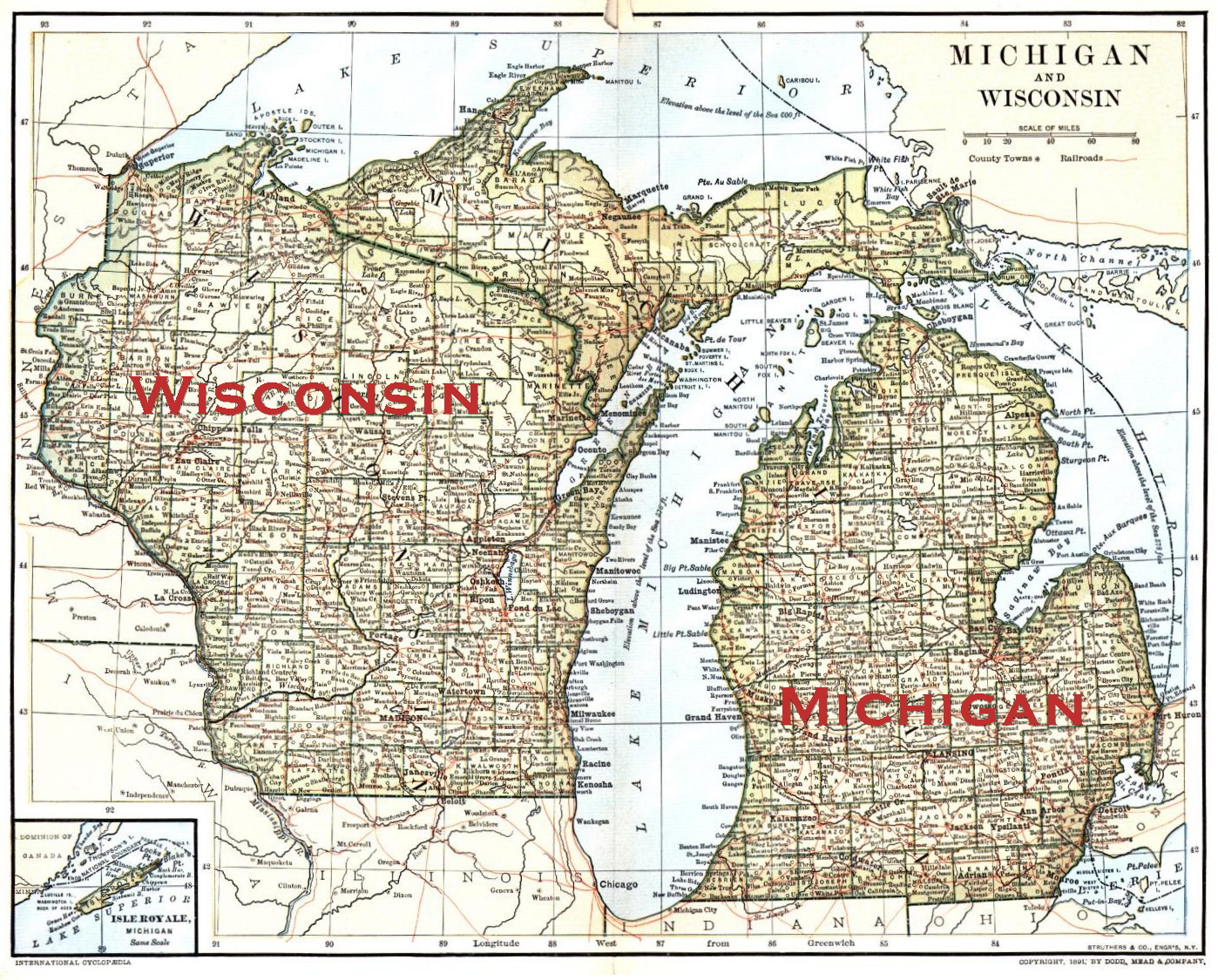
As the temperature goes down and the war heats up, Michigan pulls out its gloves and puts on its mitten (Map from:http://wiroots.org/maps/wi_mich_1891.jpg)

While the rest of the nation frets about the economy, global warming, and Mitt Romney’s hair, tensions between Wisconsin and Michigan have been escalating. The Wisconsin board of tourism recently started a campaign to lure people to the state by depicting Wisconsin as a mitten. This enraged Michigan who has long been luring people to its state by posing as a mitten. (They have satellite images to prove it.) I’m sure you’re aware of how effective this has been. You want a vacation without the hustle and bustle of working people clogging up the streets as they go to and from their jobs? Then Detroit is your place; your Michigan fits your desire like a mitten.

What the people of Michigan have failed to understand, because I have not yet revealed it to them, is that the tourism campaign is actually a federally funded study on the effects of beer on Wisconsinites. (People here drink 38.2 gallons per person per year, which based on drunk driving arrests is probably about 30+ gallons too much.)

As part of the study, the members of the tourism board were forced to sit in a room with nothing but a large map of Wisconsin and an unlimited amount of beer. Although it took one member just three beers to see Wisconsin as a mitten, it took most of them six beers to see it. The lone holdout had to stand in the corner, squint, and drink another beer before he saw it.

The government is developing a rating system for tourism campaigns in every state and soon you will start seeing a little beer steins as the bottom of posters and flyers based on the average number of beers needed to understand or appreciate them.

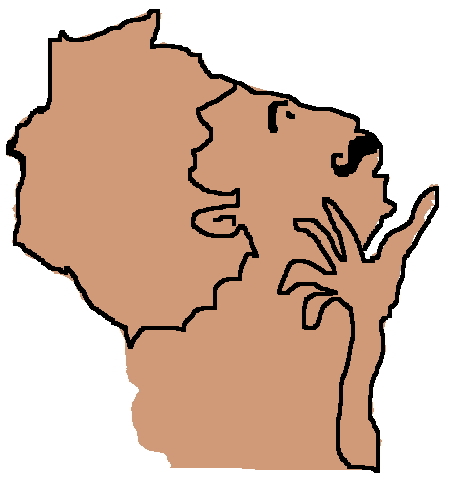
Unfortunately, I am not a beer drinker, so I can’t see the mitten in the map. I may have to do my own study using wine. I’ll keep you posted. However, I was able to do about 90 minutes of research by squinting at a map of Wisconsin during a recent meeting I attended. I saw two things.

First, I saw a man gargling Green Bay.

Gargling Green Bay

Second, I saw a man with his hand at his throat wondering where he lost his mitten.

Where is that mitten?

As your Mitten War correspondent, embedded in the throat of Wisconsin, I am thankful that so far only words and images have been hurled about, But I’m worried; the only thing keeping Michigan’s mitten from grabbing Wisconsin by the throat is Lake Michigan.

Cosmetic surgery for words

Standard

I like to think of myself as an Italian cosmetic surgeon for words. Let’s say a word walks into my office and says, “Doctor, I’ve been a noun all of my life. People look at me and think of me as nothing more than a thing. But inside, I feel like I’m a poet. I see things and I want to describe them. Can you help me be an adjective?” Then I say, “You’va come to the right a-place. I’m-a gonna affix you.”

Okay. I know what you are thinking: when did she learn Italian? Well, I was there for three weeks two years ago. Plenty of time to learn the basics.

Prefixes and suffixes are the two most familiar affixes in English, but they shouldn’t be used willy-nilly. You must also know when not to use them. So let’s start with that.

Let’s suppose you have some chocolate and someone in your family discovers where you have hidden it. You have hidden it because you want to protect that person from avarice. We all know that avarice means “an insatiable desire for gain,” and if that family member were to have access to your chocolate, that insatiable desire would cause him or her to gain weight. You hide your chocolate, not because you are greedy, but because you don’t want that person to get any fluffier, and you don’t want to be forced to attach the suffix “-icious” to avarice and call that person avaricious. In this case, you have saved your loved one from being called an ugly name, and equally if not more importantly, you have saved your chocolate.

In our second scenario, your loved one has gone to the store for milk. You are almost out and that makes you anxious because you need it for your next cup of coffee. To deal with the anxiety, you remove your chocolate from the new hiding place in the bottom pull-out drawer in the pantry, take it out of the empty coffee can, which your loved one never opens because he doesn’t like coffee, and savor it with your coffee and the last of the milk. In your chocolate euphoria, you search your mind for a word to describe what you are feeling, and there is “-icious,” whispering to you that it means “full of.” You savor the word; you are chocolicious. You are full of it.

Thanks, nodgecomb

Standard


That great Word Census, known as the OED, keeps records on the words populating the minds and mouths of English speakers. Some words, like “double,” have been around since 1290 doing twice the work of most verbs. Others die young.  For instance, “nodgecomb,” called both a simpleton and a fool, grew up in England in the 1500s and then suddenly died. We have no record of why he died, so there’s no way to dispute my claim that he was killed when he was caught poaching. At that time, most of the forests in England belonged to the royals, and under the sumptuary laws of Elizabethan England, unless you were granted a royal license, you could not hunt. Punishment for poaching included hanging, castration, and blinding. Few people know this (and I didn’t even know myself until I thought of it), but since the price for poached deer was so high, the English peasants began raising chickens and poaching their own eggs instead. If you had poached eggs this morning, you have nodgecomb to thank.


At this point, I probably should insert a line of little asterisks, but I’m not sure, so please just go the next paragraph. It also has something to do with the OED.

In the December census, the OED listed “posilutely” as a newcomer. Although it was born in 1988 in a dog’s mouth (Dodger in the movie “Oliver and Co.), it’s now safe to put in your mouth; it has the OED seal of approval, so you won’t get germs. I don’t know if its counterpart, “absotively,” is in the OED because I don’t have a bookshelf big enough to hold that many volumes or a bank account big enough to buy it.


They have an online subscription that I am considering. I hope by the time I sign up “nodgecomb” has been revived. We have a lot in common; not the poaching part, the simpleton part.


Awards for the rest of us

Standard

When I started blogging, I checked the Freshly Pressed homepage to find blogs to read. Then I discovered the Topics page and searched that way. Once I found blogs I liked, I checked out their blog rolls or went to the blogs of those who commented. On those blogs I found more blog rolls and more comments.


I don’t cook anymore because I’m too busy learning how to make (and spell) bouillabaisse; my house is a mess, but I know how to make environmentally safe cleaning products and how to organize my closets; and I rarely speak to my husband because I’m too busy reading the five blogs I found that tell you the secrets to a happy marriage. Plus, there’s the stat-checking, which reminds me.


Hi. I’m back.


But that’s not what I want to talk about today. Yesterday I did check out Freshly Pressed, and I saw somebody I knew! In blog talk, that means a blogger that I follow and who follows me. Unlike in the real world, in the blog world, you want a bunch of strangers to follow you. Whoever has the most stalkers wins. But to have stalkers, you must stalk; so it’s difficult to know who is following who. It’s like riding a carousel but without the music. I’m the one on the Palomino.


But that’s not what I want to talk about today either. (Going round and round like that makes me dizzy!) Kate of Views and Mews of Coffee Kat got Freshly Pressed. Not Kate herself because that would hurt, but her blog. Go see right now; there is not a wrinkle in sight. That’s how good those WordPress ironers are.


Congratulations, Kate. Don’t worry about the rest of us and our wrinkly blogs. We’ll manage somehow.


I’ve been tirelessly working on a list of awards for the rest of us. See below. Please feel free to add your ideas.

Freshly Blessed – for blogs with a spiritual emphasis

Freshly Blessed


Freshly Dressed (fowl division) – for cooking blogs

Freshly Dressed (fowl division)


Freshly Dressed (human division) – for fashion blogs


Freshly Messed – for blogs about home renovation

Freshly Messed


Freshly Stressed – for mommy blogs

Freshly Stressed


Freshly Tressed – for blogs about hair styling


Freshly Tressed


Pressed Flesh (G-rated) – for blogs about pregnancy

Pressed Flesh (G-rated)


Frenchly Pressed – for blogs about coffee and the French press

Frenchly Pressed

Crossing the frontier of childhood

Standard

Our nearest neighbor, The Golden Gate Bridge

The party started at Shakey’s. All of the other girls had already passed over the border from twelve to thirteen; we were celebrating my crossing. The twelfth year had been all uphill; my childhood treasures abandoned one by one as I slogged upward. The changes in my body made the climb harder, but I believed that if I reached the marker “Thirteen,” I would arrive in a place closer to freedom, a place closer to where dreams lived.


After the birthday pizza party, the girls came to my house for a slumber party. We lived in military housing on Fort Baker, a small Army base sitting across from San Francisco in Marin County. Our nearest neighbor, the Golden Gate Bridge, bore the scrawl of our names on its pillars. My stepfather, an Army Captain, defended us from the communists by working in the Nike missile program. We lived in one of the large duplexes up on the hill above the parade grounds.


Mother met Ralph within months of my daddy’s death. My father may have been the love of her life, but he was gone, and she needed a man. Her need, so much more than a want, compelled her to go in search of someone to marry her and take care of her. She searched in all the wrong places, but she found her man.

Our house on Fort Baker (photo taken over 20 years later)

Mother met Ralph at a bar; he was seven years younger and a first lieutenant in the Army. She was out dancing and drinking, doing her best to stop being a widow. She succeeded; less than six months after they met, they married. At that time we lived in El Paso, and Ralph was stationed at Fort Bliss.


After they got married, the dancing stopped, but not the drinking. Mother had married an alcoholic before, so you would think that she could recognize the signs. She didn’t, or maybe she didn’t care. She had someone to share her bed and her expenses; she wasn’t alone anymore.


The night of my thirteenth birthday party, Ralph went to Happy Hour. He always stayed longer than an hour, and it never made him happy. He came home late, while my friends and I were in my bedroom, laughing, whispering about boys, and eating snacks.


Ralph never liked my sister and me, and the older we got, the less he liked us. Particularly me. He talked ugly when he was drunk, so I was used to being called a bitch and a little whore, but I never thought he’d call my friends that. He did. Then he told them to get out of his house. Now.


I can’t remember much of the chaos that followed. I think my mom took the girls home. One or two lived in Sausalito; two of them lived in Marin City. I do remember that Ralph passed out in the bedroom he shared with my mother.


Sometime after midnight, my mom packed suitcases for all of us. Then we got in the car to drive to Texas to my oldest sister’s home. Mother took all the cash in the house, including a piggy bank made from an empty soap container that belonged to my three-year-old brother. Afraid that Ralph might hear the car engine, she put it in gear and let it roll down the driveway before starting it.


My sister welcomed the four of us into her small three-bedroom house, already full with the five of them.  Ralph sobered up and pled with mother over the phone until she agreed to go back. It will never happen again, he promised. Whatever he felt for mother or for us never looked like love to me, but maybe it was. Or maybe he needed a wife and a family to get promoted. He had his reasons, and she believed him or pretended to. I told her I wouldn’t go. My oldest sister invited me to stay; she understood why I couldn’t go back. She had lived the same story; in fact, all of mother’s children did or would. My daddy had been her stepfather, and he had never liked her; so she ran away at 17, got married, and had her first baby when I was two years old.


I spent a year away from home and loved living with my sister, her husband, and three children. I never noticed the cracks in the foundation of her home, but that year the walls still stood and they sheltered me. Within a couple of years, the walls crumbled; my sister fled, abandoning her children.


During that year, I had time to heal some of the wounds and forget some of the ugliness. In the middle of my freshman year at Irvin High School in El Paso, Ralph got orders for Alaska. My mom wanted me to come with them, and I agreed.


They came from California to Texas to get me, and in January of 1965, we drove up the ALCAN Highway to Fort Wainwright in Fairbanks, Alaska. It looked like a new beginning, a new chapter in our lives, but it wasn’t. That first chapter wasn’t over yet.


It’s a simple story, with more pain than some, but less than others. Standing on the peak of thirteen, my childhood looked to be a million miles away, the pathway back, long forgotten. On that first summit of my teenaged years, I thought I would be able to see the world, or least find a clearly marked path that would lead me to my dreams. I didn’t know what they were yet, but was sure I would recognize them once I saw them. No one told me it would be so hard. I had two choices: keep climbing or go through the dark valley. I chose the dark valley.


 

In which I reveal the secret to Midwestern kindness

Standard

Saints get all the credit. I should know: I live with one. My husband is a saint, and no, his name is not Bernard. I need milk for my coffee; he’ll go to the store for me. It’s during a blizzard? That’s okay; he’ll drive. The car won’t work? He’ll take the bike. The bike has a flat tire? He’ll walk. His shoes are missing? He’ll go barefoot, in the snow, uphill, both ways. You get the idea. And I get my milk.


Could you hurry. My coffee's getting cold.


But I would like a little credit for myself, folks. He may be a saint, but I am the saint maker. Where would he be today if I didn’t cry, moan, yell, slam cupboards, pout, and stop talking to him because he once again failed to read my mind. My thoughts (as you know) are very simple, so it shouldn’t be that hard.


No one realizes how creative a woman has to be to come up with new ways to try his patience. If I didn’t do this, he would get flabby and all the other saints would laugh at him and throw sand in his face. I am like a heavy weight he has to lift up everyday,  the barbell that keeps him strong. You can call me Barbella, AKA the Saint Maker.


As much as I would like to take full credit for his saintliness, I won’t. Midwesterners are famous for their kindness and humility. My husband proved that by marrying someone from Texas, where even our anti-littering slogan is belligerent: Don’t mess with Texas. (Note to readers from Texas: Bless yer pea-picking hearts; y’all rock!)


It took me four years of living in Wisconsin to discover the source of their kindness. As sure as fish will fry on Fridays in every restaurant in the state, bratwurst will cook on barbecues throughout the summer. These are a cow’s or a pig’s “wurst” nightmare: German sausages made of chopped meat, usually grilled but sometimes pan-fried, and often poached in beer before the grilling. (Note to non-German speaking readers: “wurst” means sausage.)


Yes, all that kindness comes from German sausage, or brats, as they are affectionately called. You need to drop your jaw and make the vowel sound “ah” as in “father.” Otherwise, you’ll mistake them for those other people’s children that keep corrupting yours.


Here’s how it works. The small Midwestern child sits in the back of the car looking out the window. All school year he has been learning to read; now it is summer and his parents are taking him and his sisters to the park. He likes to read the signs, and the one-syllable words are the easiest. At the stoplight, he turns and looks at the familiar restaurant. They’ve put up tables and chairs outside, along with a large grill. A freshly painted sign hangs over it all: Brat Fry. The child’s jaw drops, but he is too afraid to say “Father, what does it mean?” He learned in school that “a” has the sound of “apple.” He is a little Newton, and the apple drops on his head, knocking some sense into it.  No one needs to tell him again to be kind and stop acting like a brat.


Now you know.