After Finding a Cure for Breast Cancer, Would Someone Please Answer My Question?

Standard

It’s Breast Cancer Awareness month, and I want to be serious and say something really profound, but in the midst of so much awareness, I keep pondering a question that I feel demands an answer: why do we call them training bras?


I mean, what can you train them to do? When you get them, they already know how to sit up and fetch (in a manner of speaking). But when they grow older, they just lie down and play dead. That’s it. No other tricks, no opposable thumbs, nothing, nada.


But since October is Breast Cancer Awareness Month, I want to be supportive. Or at least say something uplifting. Get things off my chest. Make a couple of points. And yes, I know that I am pun-ishing you. I can’t help it. (And the beauty of the internet is that I can’t hear your groaning.)


Don’t neglect getting your mammogram and check-ups. Early detection gives you a greater chance of beating the cancer. You can read about some of the latest research at the Susan G. Komen for the Cure foundation. The backstory is inspiring: a promise to a dying sister starts a worldwide movement that has touched millions of lives and helped save many of them.


Now I know what I’m going to make my sister promise when I’m on my deathbed. Find out why we call them training bras.

What Part of the 99% Are We?

Standard

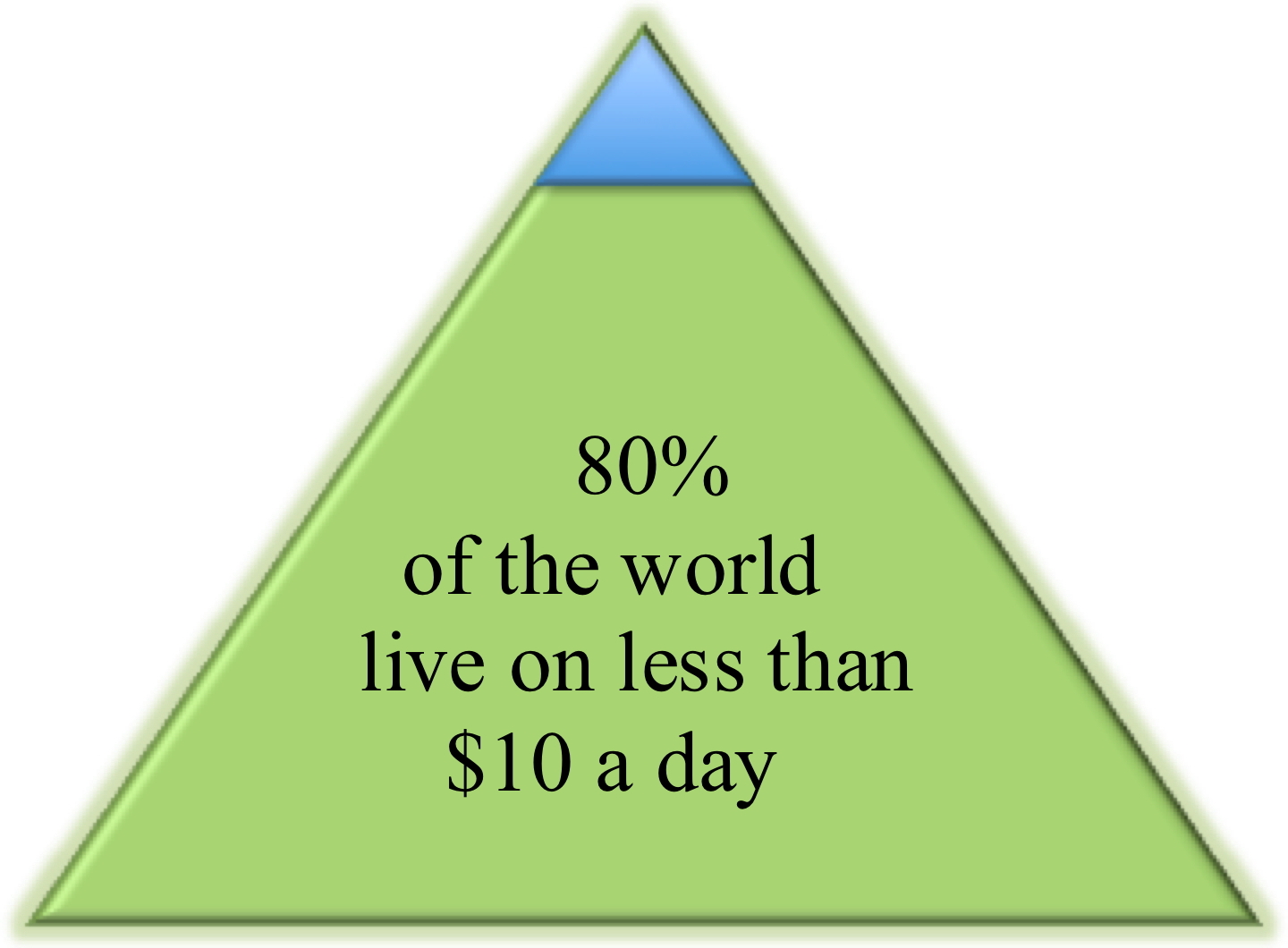
In America, 99% of us fall into the lower portion of the first pyramid. More and more of us are falling faster and faster to the bottom, losing our jobs, our homes, and our future on the way down. We need change.

But we’re only about 300 million people out of nearly 7 billion in the world. And very few of us fall into the lower portion of the second pyramid. We’re part of the developed world, the upper 20% that consumes between 60%-80% of the world’s resources.

Those of us who are part of the 99% in the first pyramid look at the 1% above us, wondering how and why so much wealth and power ended up in their hands. Maybe we think about how nice it would be to shake loose some of the change in the pockets of the super rich. And maybe, just maybe, all of the billions below us on the pyramid are thinking the very same thing about us.

Change is good for us. Change is good for all of us.

Go here and here to think about change.

Lovesome Words: Matriculant*

Standard

Neighbor:                   How are your children?

Yearstricken:          A few months ago, my youngest child became a matriculant.

Neighbor:                  That sounds awful! Is there any cure for it?

Yearstricken:          Money. Lots and lots of money.


*One who enrolls in a college or university.

In Which She Rationalizes Her Addiction By Blaming Her Mother (I Miss You, Mom) and Realizes That the Title to the Post is Probably Going to Be Longer Than the Post

Standard


When my mother gave birth to five pounds of cranky, she believed she would never sleep through the night again. It was my firm belief that days were for sleeping and nights for crying. Mother’s lack of sleep was her steppingstone to drug use. Not for her, for me. The kind of drug that millions of people use everyday – highly addictive,  yet perfectly legal. She dosed me with caffeine by putting a small amount of coffee in my bottle to give me a buzz during the day. I was still grumpy and hard to please, but I stayed awake long enough to begin sleeping at night.


In the picture, the tall, happy one with the golden curls and Gerber baby smile is not me. That is my annoyingly photogenic sister. I am the dark-haired one, with eyes squinched and fists clenched as if to say, I don’t know who brought me here, but someone’s going to pay. And where is my coffee?


Warning! This is a Rant

Standard

Long ago, in a century not unlike this one, except that women wore more clothes and you hardly heard the f-word and people were better drivers and they wrote letters. On paper. With ink. And their very own hands. Without the aid of machines! Mind-boggling, no?

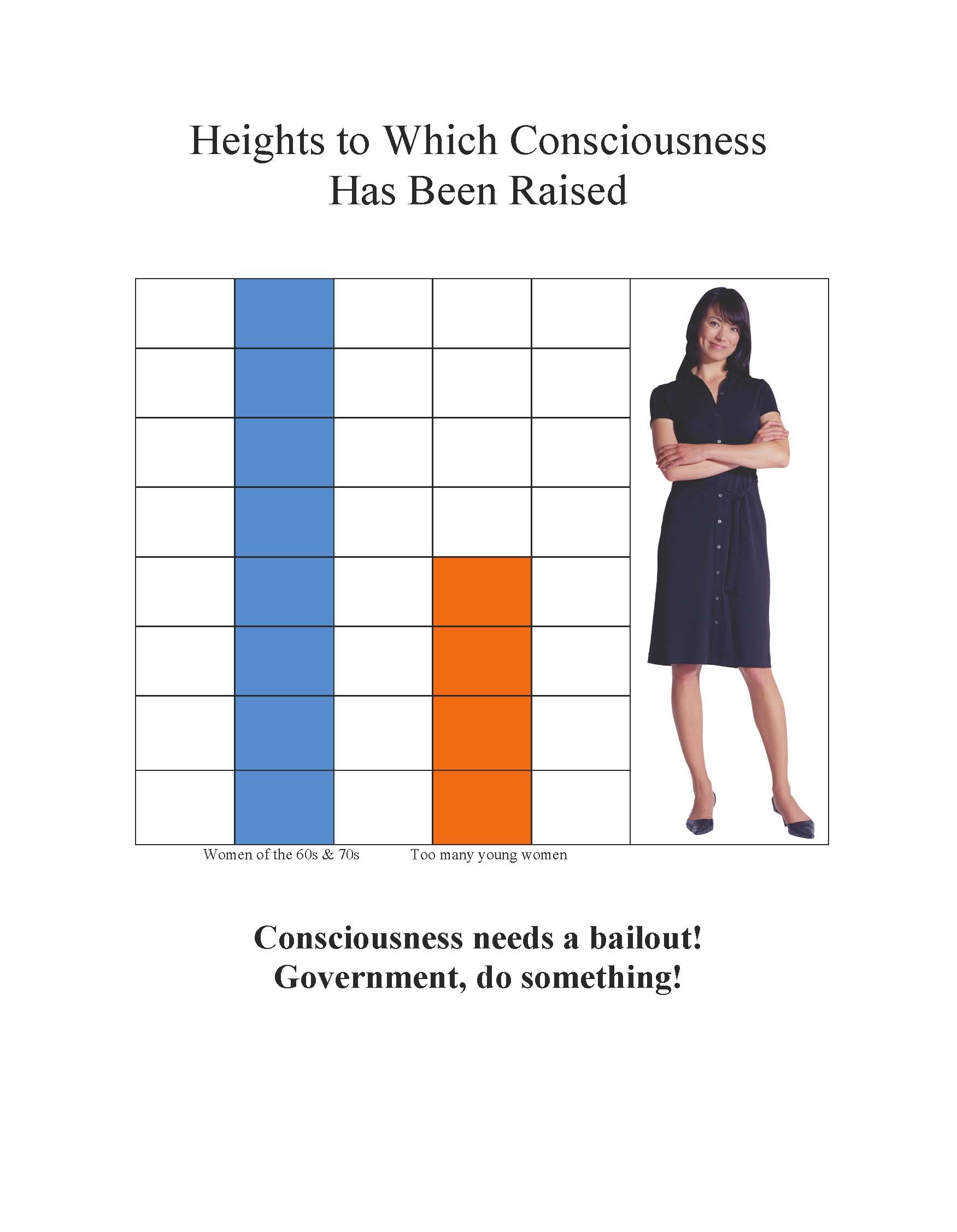
Where was I? Oh yes, my rant. It’s about the heights to which consciousness has been and is being raised. Back in the 1960s and 1970s, women met together for consciousness-raising. They were tired of being second-class citizens and wanted equal pay for equal work. Also, they wanted to be viewed as something more than sex objects. When I was in college, I attended some of these sessions. And while I admit that along with the rest of my body, my consciousness may be sagging a bit, there are a lot of consciousnesses out there that needed to be winched up. (WARNING: cane is raised!)

Every time I see young women call themselves whores while wearing their 90%-off clothing (and I don’t mean the price), or hear about a poll in which a majority of young teenaged girls would rather be sexy than smart, my consciousness gets a headache. This is not the road to equal pay for equal work. (What? We’re still on that road? Sadly, yes.)

Now, for the rant: Why,when I was your age, my consciousness was this high (points to head). Yours looks like it’s stuck right there (points to lower body).


Are You Carrying Secrets?

Standard

As a child, when you first begin to carry secrets, you hold them externally, like a package of eggs, always conscious that you mustn’t drop them. Sometimes you forget that you have them, but if the conversation heads in a certain direction, you panic, check to see that none are cracked, and become once again painfully aware of your charge.

Later you internalize the secrets. If you brood over them too much, they may hatch and breed.

By adulthood, most of the eggs have cracked, been dropped, or lobbed at someone. It can take a lifetime to clean up the mess.

I remember a story on NPR’s “This American Life” about a choice of superpowers, either invisibility or the ability to fly. One woman said emphatically that everyone, if they were honest, would want to be invisible so they could spy on others. She obviously had never been privy to very many secrets. I have heard enough, carried enough, and still carry some that I wish I didn’t have to.

So now I blog. And what are most personal blogs but a whispering of secrets.

Eight Life Lessons from Driving Miss Crazy

Standard

1. Nobody likes a tailgater unless your vehicle is stopped, your tailgate is open, and you’re serving hot dogs and hamburgers. (Although I’d really prefer chicken.)

2. Some babies need a binky in their mouths at all times; you do not need a cellphone stuck to your ear at all times. Try sucking your thumb instead.

3. Don’t weave back and forth; this isn’t a loom or hair salon.

4. Don’t pick your nose. It’s hard for the rest of us to see you struggling that way. Perhaps you have not heard that most car windows are not opaque. Learn this.

5. Remember the song “Where is Thumbkins?” Remember Mr. Tall Man? Well, when it looks like everyone in your rearview mirror is singing that song and showing you Mr. Tall Man, remind yourself that most adults no longer sing that song. Maybe something else is going on, like your driving.

6. Don’t speed up when someone tries to pass you. Maybe that’s why you keep seeing Mr. Tall Man. (Review lesson #5.)

7. Learn car language: a blinker means please, a horn blast means watch out, many horn blasts mean I’m this close to ramming into your car, and a loud crash means I rammed into your car, but I have insurance, do you?

8. When someone’s blinker is asking you to please let them in, be nice. Even if we are going to a dead-end job, most of us prefer to arrive at work alive.

Tailgaters

Standard

Why do drivers think I will go faster if they get so close that I can see their nose hairs? I don’t have any extra nose tweezers for them, and if I did, how would I give the tweezers to them. Throw the nose hair clippers violently through their windshield while doing 65 mph? Hmm, that actually sounds quite nice.

I need a bumper sticker that says, “I brake QUICKLY for tailgaters.” Or maybe, “I BREAK arms and legs of tailgaters.”

Wish me luck on my morning commute. It looks grumpy outside today.

Speaking Texan

Standard

El Paso is the last place west before you arrive in “not-Texas.” It lies on the tip of the finger pointing to the end of the world, or California as most Americans call it. I just missed being born in either a new or an old Mexico.

Growing up, I never knew I spoke Texan. It wasn’t until I ended up in California during sixth grade that my classmates informed me I talked funny.  How was I to know that vowels could stand alone and speak just one sound? It seemed lonely somehow. When you needed a vowel in Texas, you called out “ya’ll come,” and they would come in pairs or threes all set to dosey-doe right out of your mouth into that dance of words that I now know is Texan, but thought was American until I went to California.

People fled to California to forget where they came from.They started fresh, leaving behind their former lives and vowels. Back home, the vowels were round and full like a bubble, and you blew them out slowly, enjoying their colorful sounds. You savored your words just as much as you did your mother’s cornbread, letting the vowels melt slowly till your words were drenched in their buttery sounds.

I had an ear for sounds and was a natural mimic, so I managed to adapt quickly to my new friends on the west coast. At that age, to talk funny was worse than having pimples because everybody knew those signs of adolescence would eventually go away. I learned the new way of talking; however, I would occasionally break out with “ya’ll” and hope that no one would draw any attention to it.

When I went back to Texas for my last year of high school, I felt like I talked funny. I switched back to Texan, but I’d lost the fluency. Hearing people speak in my mother tongue soothed me. I knew the music, but I’d forgotten the words of the songs. And now, I could hear the accent.

People on TV and in the movies speak like Californians–too quickly and with their unsociable vowels. Only cowboys, rednecks, and the uneducated speak Texan. Their rich, slow talking is usually depicted with condescending amusement as if they are children just learning to talk and mispronouncing the words. It’s cute, but you hope they grow out of it.

A good part of my adult life, I lived overseas. In the international community, I met people from many English-speaking countries. We all thought the rest of the English speakers had an accent. It’s amazing how plastic and moldable the vowel sounds are. The British may have the strongest claim to real English, but for me, it’s the cowboy, not the king, who speaks English the best.

Occasionally when I meet someone for the first time and they ask me where I’m from, they’ll say, “Well, you sure don’t sound like you come from Texas.” It’s true. I’m like someone who gave up piano at a young age and now is sorry they did. I will sometimes say a few lines in my best Texan accent, and that seems to satisfy them. It’s small consolation to me. But when I visit home and hear somebody speak real Texan, or when I unexpectedly slip out “ya’ll” in the middle of a conversation, I’m as happy as a chigger on the belly of a fat man.