Why all the fuss about youth in Asia?

Standard


Why road

Why are we heading in this direction?


I do a fair amount of driving. Some of it involves my car, but a lot of it involves driving people crazy. I know every back road to crazy there is and can get you there faster than you can buckle a strait jacket.


When I drive my car, NPR (National Public Radio) or WPR (Wisconsin Public Radio) often rides shotgun. They always have something interesting to say, and of course, I have interesting things to say back because, yes, I talk to the radio. Don’t you?


Many of their programs allow people to call in with comments and questions, and whenever the topic is healthcare, someone inevitably mentions youth in Asia.


What exactly are people so afraid of? Have youth in Asia done something to them? Should I be afraid? Is there some conspiracy going on that people are trying to prevent me from knowing about?


I have lived in Asia, and I had no problem with the youth there. Yes, there are a lot them, but I think there are youth everywhere. I’ve seen quite a few at the mall near my house.


Dear reader, are you equally troubled and full of questions? I assume you are if you are reading this blog. And I bet I know which question you are asking right now: Are we there yet?


Singapore_Road_Signs_-_Warning_Sign_-_Slow_down


No, dear friend, not yet. Crazy is just a little further down the road.


The secret to eating more vegetables

Standard

If you had only listened to your mother, I wouldn’t need to write this post today. “Eat your vegetables,” she said. But did you listen? I think not. Otherwise, the government would not need to keep reminding you to eat them.


First, let’s begin with how to recognize a vegetable. In the wild, if it squeals, whinnies, moos, squawks, or swims, it’s not a vegetable. In the supermarket, look for bones, blood, and gristle. These are dead giveaways that you are looking at a different food group. Vegetables do not and have never moved. Be careful not to use the lack of movement as your only definition. Otherwise, cakes, cookies, candies, and pizza can easily be misidentified. These so-called foods are not vegetables.


Many people do not realize that those colorful and leafy products in the produce section of the supermarket are not decorations or gardening plants. Those are the edible plants known as vegetables.


More than your refrigerator's bottom-drawer petri dishes used for growing mold

Vegetables: More than your refrigerator’s bottom-drawer petri dishes used for growing mold


According to the DGAC of the HHS ODPHP and USDA CNPP* (U.S. Departments of way too many acronyms), people (you) are not eating enough vegetables. Many people have told me that I have a peculiar insight into these kinds of problems. In fact, some say it’s a very peculiar type of insight. So, as a public service, I am revealing (for free) the secret to eating more vegetables.


1. Buy vegetables – you can find fresh ones in the produce section of your supermarket. Avoid the inner aisles of your grocery store where they place the embalmed ones in cans.


2. Remove any wrappings. Sometimes vegetables are tied up with little wires. Right-tighty, lefty-loosy will not help you here, so do your best. If you have difficulty, cut the wire with kitchen shears.


3. Prepare the vegetables. This may require a level of manual dexterity you have not reached yet. If you don’t feel comfortable holding a knife or if others don’t feel comfortable when you are holding a knife, merely wash them and ask others to prepare them.


4. Put the vegetables on your plate.


5. Use a fork to spear a piece of a vegetable or use your fingers to pick it up. It’s not unheard of to use a spoon for vegetables that come in small pieces, like peas.


6. Put the vegetables in your mouth and chew. Don’t forget to swallow.


You will be amazed at how these deceptively simple steps will help you eat more vegetables.


Having trouble visualizing these steps? For just $9.99 you can purchase my 60-minute video demonstrating these methods. But wait, there’s more. If you act now (instead of just sitting there), for an additional $9.99 I will also send you my “Secrets to Eating More Fruit.” This patented method of “fruit installation” includes hand-illustrated diagrams as well as pictures of real fruit showing you how to get it inside your digestive system. (Note: The book has graphic content that may be offensive to some people who don’t like the way I draw.)


Since my patented methods have not yet proved patently false, I’m now offering to help you serve yourself in the same way I serve myself. And just to show you how self-serving I am, tomorrow I am giving away copies of my other most recent book, The Magic of Mastication: Unmasking the Mystery of Meaningful Mouthfuls. I guarantee it will give you something to chew on.


*Dietary Guidelines Advisory Committee of the Health and Human Services Office of Disease Prevention and Health Promotion AND the United States Department of Agriculture’s Center for Nutrition Policy and Promotion


Frequently Not Asked Questions: Six

Standard

How much money do you make?


None.


It’s illegal to make money unless you are the federal government, so I’m surprised you would ask me that.


New_five_dollar_bill

Please note that Lincoln looks reserved.


Like me I’m sure you have bookmarked Article 1, Section 8, Clause 5 of the U.S. Constitution, which grants the federal government the right to “coin” money. That meant gold and silver. Our Founding Fathers distrusted and eschewed* paper money, so they expressly prohibited states from “emitting” it.


You probably also know that Abraham Lincoln signed the first U.S. federal emission law allowing the government to print bills. In 1862, government IOUs in the form of “greenbacks” began circulating their way throughout the land until they landed in the pockets of the rich. It’s been that way ever since. The government called these bills Tender Notes, which I find rather endearing. Now, of course, the government no longer sends out Tender Notes; instead, they send out Reserve Notes. On our new colorful missives, the government promises that the Federal Reserve Banks have purchased enough U.S. Treasury securities (i.e., government debt) to cover “all debts, public and private.”


If that doesn’t make you feel secure, I don’t know what would. As a nation, we have debt coming out of the “wazoo” (French for “Congress”), and as of today, it stood (momentarily) at $16,804,904,109.526, give or take 25 cents. An endless supply of debt means an endless supply of securities, which means an endless supply of Reserve Notes promising to cover any and all other debts.


Please note: The writer of this blog reserves the right to interpret history and facts in a manner that tickles her fancy. If your fancy starts to itch when reading this post, please stop immediately and read your nearest economics book.


*Use of the word “eschew” entitles any writer or reader of this post the right to liberate one piece of chocolate per writing and/or reading.


The great menace

Standard
Those arms may look inviting, but sit there at your peril.

Those arms may look inviting, but sit there at your peril.


While Americans have been watching reality TV, the other reality, the real one, has been walking the empty streets of America, unhindered and free to do its insidious work. Thankfully, I eschew* reality TV and have been looking out of my window with my binoculars, so I know exactly what reality is up to.


What I have discovered is that an ever-growing, never-stopping, constantly encroaching horror is heading our way. Yes, another –ism is threatening our way of life. And this time, I think we are losing the battle. Although we have successfully fought and overcome communism, fascism, chauvinism, sexism, cubism, and tourism, I don’t know if we will be able to stop this new menace: horizontalism.


Don’t let the name of the movement fool you. This has nothing to do with napping, a perfectly normal and healthy hobby enjoyed by many. No, this refers to body sprawl, when ones frame enlarges and takes in more and more of the scenery.


The food-furniture complex, a nefarious alliance much like the military-industrial complex, has created conditions leading to the deliberate horizontalization of Americans. It is a well-known, fully established mythical fact that the size of the tank determines the size of the fish, but did you know that the width of the recliner determines the size of the hips? As recliners have grown larger and wider, so have Americans. And if we dig deeper into recliners, what do we find? Cheetos, jelly beans, caramel popcorn, and broken pretzels. Show me a recliner, and I will show you crumby evidence of the unhealthy food cabal wedged within. If that isn’t ipso facto Nabisco, I obviously don’t know what ipso facto Nabisco means.


The threat grows greater every day. Even as you sit there reading this, horizontalism is spreading. The powers that feed and seat us control millions of Americans, each body a bilateral movement expanding in a parody of Manifest Destiny, seeking to reach from side to side (or thigh to thigh) of that comfy recliner. I have a haunch that it will continue until we get up and do something, anything.


Fight horizontalism today or it will get all of us in the end.


*On this website, each time a writer uses the word “eschew,” a piece of chocolate is released from its wrapper and set free to become one with the universe (i.e., yearstricken).

Sinister recliner

Mismatched memories

Standard

The house we do most of our living in sits across from the smartest block in our city. The north side of the smarty-pants block hosts an elementary school, the northwest corner lends its land to a charter school, and the south side carries a middle school on its back. Mornings and afternoons cars line up outside the schools, disgorge or engorge students, and slowly drive off into whatever comes next. Some children, however, still walk to school.


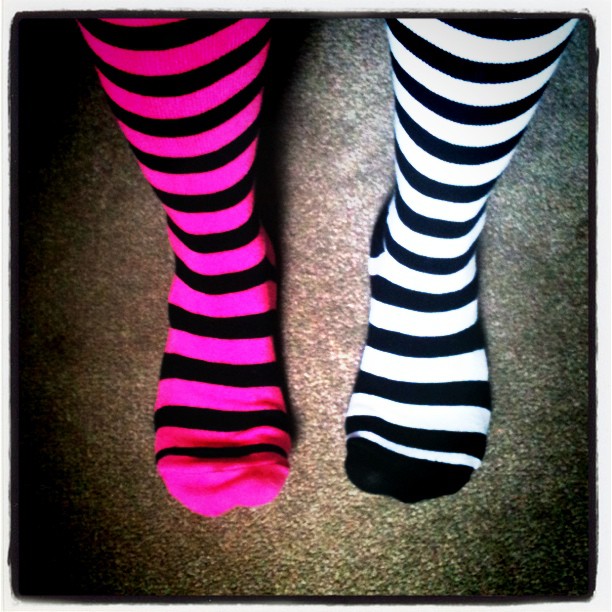
6018492132_cc9b8ef6b3_o

The other day as I was driving past the middle school, I saw a girl wearing one white sock and one black sock. Suddenly those socks were to me, what that madeleine was to Proust. The only difference between our experiences is that I didn’t have to eat the socks to invoke my involuntary memory and Proust did. He ate, of course, a madeleine, not a pair of socks, which if he or I had done would have merely invoked an involuntary gag reflex. Oddly, that is my exact response when I remember junior high and its humiliations.


My memories of that time center on the betrayal of my body. As a young child my body took care of me, balancing me on bicycles and roller skates, walking me to school and back, and carrying me through those early years without asking much in return. A band-aid for a skinned knee, a dreamsicle on a hot summer’s day, and whatever clothes I could find, mismatched or not, satisfied it.


Then the change came. In health class I watched the educational films about the wonderful changes waiting for me when I arrived on puberty’s shore. I would turn in my child’s body for that of a beautiful young woman, except I didn’t. I had the same body, only pimply, hairy, and lumpy in all the wrong places. Worst of all, I could not go back to my pirate days or run wild through the neighborhood seeking adventure.


Now I had an awkward body to shower, with legs and underarms that needed shaving, and parts that needed straps and hooks to harness in (the special underwear of the initiated). Everyday I had to present this new body to the world to be judged by its impossible standards of beauty. My body elicited comments, mostly from boys but also from girls, about its lack of conformity to the beautiful women who lived in our TVs, danced across our movie screens, and permanently resided in our minds. I had never been a stranger to self-consciousness or public embarrassment as a child, but most of the time I was free from of it. When the changes came, I picked up that terrible burden and carried it with me everywhere I went.


il_570xN.111406602

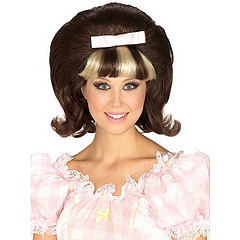
Sadly I never had such a large bow nest in my hair.

My hairstyle of choice during junior high was a bird’s nest. My top hair, cut short, was first permed, and then rolled into obedience each night. On good hair days, with teasing and hairspray, the bangs poofed down and the top poofed up creating an ideal place for a large velvet bow to perch. The rest of my hair was left long. By lathering it in Dippity-Do and sleeping on rollers, I could flip the ends upward and outward like bird wings. It’s what all the bird-brained girls did.


The worst class of junior high was PE because we were required to take showers, and the teacher stood near the open showers to make sure we all went through. Each day I faced the task of deciding how I would humiliate myself.  I was allowed only one small towel, so I could either cover my body as I ran through or cover my hair to protect my hair. I was younger than most of the other girls because I started school earlier, so while their bodies looked more and more like women’s, my looked like it had started to develop and then changed its mind. Sometimes I opted for that first mortification, covering my hair; other times I opted for the second. In those cases, I could cover my body, but all or part of my hair got wet. I never knew if I would emerge with all of the long part straightened or look in the mirror to find one side still flipping up while the other side hung down like a broken wing. Almost always, the little nest on top turned into a soggy, frizzy mop.


Why did those mismatched socks I saw the other day uncover these memories?  One popular style at my school was a pleated skirt, a pullover sweater, knee socks, and tennis shoes. If you wore a white skirt with a black sweater, it was considered high fashion to wear one white sock with a black tennis shoe and one black sock with a white tennis shoe. The velvet bow in your bird’s nest could be either black or white. I could never decide which was better; both went well with the red face of humiliation I usually wore.

Winter rime and winter rhyme

Standard
_DSC3005

Winter’s minions stand their ground.


The book of days that hangs upon my wall told me more than a week ago that spring was here. I’m waiting, trying to believe it’s true.


Yes, the time of rime is now past, but winter lingers, reluctant to leave. Though the thermometer says it is 23 degrees this morning, winter sends its winds to swallow 5 degrees or more.


I brood. Rime, the ice that winter paints the trees with, rhymes with “rhyme.”


The time of rhyme is also past. Once upon a time, poets moved in measured footsteps, inviting us to join the verbal dance. Often when a line stopped and bowed its rhyme, the next one mirrored those same steps, matching the sound in kind. Some poets slanted rhymes or placed them inside, waltzing to a steady beat until the final curtsey.


These days we like our rhymes sung, whether hip-hop, pop, or rock. Our poems are free to wander, twirl, and spin. Free verse creates its own steps and feels no constraint to follow someone else’s choreography. It rhymes or not, according to its own interpretation of the dance.


I would like to rhyme and dance a poem, but I have two left feet. However, it doesn’t stop me from trying.


So, today, I’ll share a poem of winter’s end, written years ago for my children. I warn you now: should you cross beyond the yellow tape, you’ll wind up in a rhyme scene.

Rhyme Scene

                                    Winter


Sweet swift dreams buried lie,

Mourned with long and silver sighs

Winter bares his strength ice-cold,

Tyrant clothed in robe of snow.


None would even dare to try

Reason with those deathful eyes;

Piercing, chilling, large and small;

Well he knows we’re cowards all.


Oh so proud, he comes with foot

Booted.  And where once had stood

Tender creatures soft and green,

Sterile, barren world is seen.


Laughing with a blasting wind

Opens court, his reign begins.

Long he banquets, drinks the wine

Stolen from the summer vine.


Largely ‘neath his grey tent sky

Sated monarch, drunken lies

Sleeping.  Snores with white-cold breath;

All his subjects wait, in death.


Deep in dreams his lover spies,

Hoary kisses tantalize.

Then sound with laughing fingers cracks

His smooth white dream, still unhatched.


Would one dare disturb this king

Who exiled thousands born to sing;

Southern regions welcomed them

Feathered orphans, fled on wing.


Still the sound, gentle laughter,

Warmly wrapping ‘round the rafters;

Anger fills the tyrant’s breast,

“Halt!” he cries with frosty breath.


Comes a child with melting smile,

Skips and flowers multiply.

Smaller growing, puddle king,

Conquered by the barefoot Spring.


Melting minions.

Melting minions.

Stories from Miss Pronunciation

Standard

I hate to brag, unless I can do so in a manner that appears as if I am in fact being humble. It’s not easy, of course, but humility never is.


In my department at school, my ability to teach ELL students to “talk purty” has earned me the moniker, Miss Pronunciation.

Miss Pronunciation


Since it’s my first moniker, I naturally feel a bit of pride when I hear the other instructors call me that. Most of the time I can’t even mention that I have a moniker because that would be bragging, and as my husband’s mother used to say, “Pride stinks.”


To avoid even the hint of what I like to think of as verbal flatulence, I have to be discreet when I secretly but seemingly casually mention my colleague’s flattering opinion of me. Thankfully I am able to insert it into this post since there is a tenuous relationship between my moniker and the main point. Both concern pronunciation.


In a previous semester, I was the bridge instructor in a speech class for students whose first language is other than English. One of their assignments was a persuasive speech. Before the day of the speech, the students and I had time together to practice. One student chose the topic of young children and the negative effects of watching too much TV. While arguing for reduced screen time for small children, the student repeatedly looked straight at me and urged me to reduce scream time.


While looking through my notes, I was reminded of this good advice. So, for the next week or two, I plan to reduce scream time as much as possible. And I promise not to brag about it, unless I have to or can.


Rather large mouth courtesy of http://www.flickr.com/photos/rubyblossom/3222356938/

Don’t blog a dead horse

Standard

Although I am fairly, or unfairly, new to the world of bloggery, I have already learned that people don’t want to read another post about how hard it is to blog. It’s a dead horse.


You know the kind of posts I mean. The ones that say, Look everybody, I blog. My pinky aches from hitting the delete key, and my head is killing me because last Thursday I had to think of something to write and didn’t. Also, I have to chew my food, with that whole up and down jaw thing. And don’t even get me started on the walking, with the feet, first the right, and then the left. Just the chewing and the walking is hard, but add the blogging, and people, you have no idea.


I am like that, only worse. My brain is completely empty. I just stepped out of my mind for a moment and when I came back, I discovered that someone had broken in and stolen everything, including all the fixtures.  Now I can’t access any water or use the toilet. You know how you hate it when everything in your life goes down the toilet; well, trust me, it’s even worse when it doesn’t.


So, yeah, everything is fine if your definition of “fine” means sitting on the couch, holding your knees, and rocking back and forth while humming the song “Mama from the Train (A Kiss, A Kiss).” The rocking motion (my mother called it “bonking”) helps dislodge any stray thoughts the thieves may have missed.


n081968

That song I’m humming was popular when I was a small child. Its most unforgettable line is “Throw Mama from the train a kiss, a kiss.” My mother, unaware of how the refrain would burrow into my brain, allowed me to listen to it on the radio. I have no doubt that its misplaced indirect object made me what I am today, a teacher of English language learners. Now I am doomed to spend most of the day hauling indirect objects from one end of a sentence to the next; rescuing modifiers that students leave dangling over verbal cliffs; and removing fragments of sentences, which explode on the pages of my students’ writing.


The singer who popularized “Mama from the Train” started life as a Fowler, a name closely associated with Henry and his famous A Dictionary of Modern English Usage. Then Miss Clara Ann Fowler changed her last name to Page, a word associated with blankness and a demand for words. Like me, the newly formed Page suffered from bouts of alliteration and chose Patti as her first name. Forever after, she was known as Patti Page, The Singing Rage.


Do you see the connections? In case you don’t, here they are. Long ago in land much like your own, only called Oklahoma, a woman forsook her tenuous link to modern English usage and declared herself a Page (the writer’s nemesis). The Singing Rage then crooned a tune that formed my destiny and left me wrapped in a blanket, rocking back and forth on the sofa, doing my best to escape the blank page on the computer and the dirty dishes in the kitchen sink.


So you see, my inability to post anything today makes perfect sense. Or maybe my inability to make sense is perfect today.


Photo: DN-0081968, Chicago Daily News negatives collection, Chicago History Museum.


Windbreaking News: White-collar crimes

Standard

My imagination has been investigating the case of Maureen O’Connor, the felonious former first female mayor of San Diego, who “donated” two million dollars from a philanthropic foundation to a number of casinos she frequented. Apparently, she misunderstood what the casinos meant when they told her they “worked with” people who have gambling addictions.


Ms. O’Connor’s attorney, Eugene Iredale, had this to say:

 This was not, we think, a psychiatric problem or a characterological defect because there is substantial evidence that during this same time, there was a tumor growing in her brain, in the centers of the brain that affect and control, logic, reasoning and, most importantly, judgment.


Due to these extenuating circumstances, Ms. O’Connor will undoubtedly receive a lighter sentence. However, word has leaked out (snuck out by my imagination from the unexplored part of my brain) that her lawyer, Mr. Iredale, is facing charges of his own.


Like his client, Mr. Iredale is being accused of misappropriation. In her case, it involves money and affects a limited number of people; in his case, it involves suffixes and affects all of us.


n080053


As an attorney, Mr. Iredale has long lived in a lavish environment of polysyllabic diction (lots of big words) and now feels compelled to include at least one seven-syllable word every time he talks, even if it means stealing suffixes from legitimate, hardworking words. In the article on the CNN website, Mr. Iredale (now incurring ire over dale and hill) sticks a stolen “-ological” onto “character” and comes up with “characterological defect.” His crime may affect millions. Now that he has put that so-called word on the internet, people may start using “characterological,” which will cause other people to want to poke their ears with sharp sticks; and those poked-out ear people will need otolaryngological help, which will only be available if that particular suffix isn’t stolen. Clearly, this man must be punished.


Several local groups have laid claim to the suffix that Mr. Iredale so wantonly pilfered. The local San Diego Archea-……. Center insists he stole it from them. However, the Gastroenterology Department of the San Diego Mercy Hospital contends that the suffix belongs to them. Dr. Gutzman, head of the department and the man leading the probe into what happened to the tail end of their medical word, says he has been unable to treat any gastroenter-…….. problems since Iredale’s “appropriation.” In addition, Morton Liebig, has brought suit against Iredale. “I’ve been a path-……. liar all of my life, and since that article appeared on the CNN website, I have been diagnosed with WCTS (Washington’s Cherry Tree Syndrome) and can no longer tell a lie. I’m a lawyer, too, and now I’m out of work.”


The court, of course, will have to sort through these claims and make the final decision as to whose suffix Mr. Iredale stole.


According to sources in my own living room, Mr. Iredale plans to have an MRI to check the part of his brain that affects and controls “logic, reasoning, and most importantly, judgment.”


Ironic, no? Or as Mr. Iredale might say, “Ironicological, isn’t it?”


Photo: DN-0080053, Chicago Daily News negatives collection, Chicago History Museum.


Windbreaking News: Uncle Sam’s secret recycling program

Standard
n088741

Helping you out since 2001.


Welcome to Windbreaking News, where I sniff out the news for you.


Reliable sources, who just happen to live in my head, informed me of a huge recycling effort that the U.S. government operates on behalf of its citizens. Of course, it’s a clandestine operation and doesn’t look like a recycling program because it’s more fun that way.


What the government doesn’t know, but I do (thank you, sources in my head!) is that if someone informs the American public, the recycling program will take off like never before.


In 2001, Uncle Sam set up an agency and sent its workers throughout the country to help Americans recycle. In order not to alarm anyone or alert the public to their true purpose, these uniformed helpers pretended to be angry, rude gropers at security checkpoints in airports. But underneath that façade are a host of recyclers tirelessly working on behalf of the government and us, the Mer’can people. We salute you, Uncle Sam!


Since most Americans do not understand how or when to recycle, our fearless leaders set up TSA (Taking Stuff Away) to help us. These trained professionals spend day and night going through your stuff, identifying items to recycle, which you, the great untrained, failed to properly dispose of. The shame!


Agents representing the U.S government (All Your Base Are Belong to US) remove unnecessary items from your suitcases, such as electronics, jewelry, and cloth. Few people realize that your so-called “money” is a cotton and linen blend that needs to be periodically recycled.


Does this grieve you? Are you outraged? Are you asking yourself or yourselves why your weren’t informed about this earlier so you could so something about it? Well, grieve no more and stop bothering yourself(ves) with so many questions. It’s not too late. You can help the government recycle more.


The next time you fly, put your broken electronics in your suitcase. Take that awful fake ring Aunt Ethel gave you and put it in one of those velvet jewelry bags. Be sure to place it on top so the agents don’t have to dig. It’s time to participate, people. Be creative; the sky’s the limit. We can be the world champion recyclers, crushing our contenders like so many empty soda cans.

 Recycle. It’s the American way.


Full disclosure: I support the TSA and have participated in their recycling program. A while back, agents were kind enough to recycle an iPad from my backpack at a checkpoint. Unfortunately I didn’t notice until I got on the plane so I never got to thank them. I salute you, TSA!


Warning: If the egregious use of exclamation marks (aka “bangs”) in this post causes heart palpations, nausea, or ringing in your ears, please stop reading immediately; call your psychiatrist or a friend, even if he or she is imaginary. If your imaginary friend likes the egregious use of bangs, go here.


Photo: DN-0088741, Chicago Daily News negatives collection, Chicago History Museum.