Losing what you never had

Standard

I remember the first time I read the stories of the Greek gods, particularly Zeus and the birth of Athena. To most people, the idea of a full-grown daughter emerging from someone’s forehead sounds incredible, the stuff of dreams and mythology; however, it didn’t seem strange to me. Zeus reminded me of my mother who could open her mouth and speak fully grown siblings into existence.


In the galaxy of our neighborhood, my family was one of the smaller solar systems.  Daddy blazed like the sun in the center, circled by mother, his reflecting moon, and his two small planets, my sister and me. Friends and relatives, like distant stars, were out there somewhere, but we lived primarily in a world of four.


Mother had been someone’s moon before; this was her third attempt at marriage. She had escaped the drunken rages, violent beatings, and evictions of her earlier life, and found a man who loved and provided for her. As this new man drew her forward and away from those events, her memory looked back and wrote them into a story she told, but no longer lived. Daddy treated her with kindness and love, but he wanted nothing to do with her past. That included her other children, the five she had before she met him.


When my daddy was alive, I moved between two parallel worlds. In one, I was the second daughter of a loving father and his faithful wife, living a typical middle-class life. We lived in a three-bedroom, one-bath brick house with elm trees in the front and a swing set in the back. In the parallel world, I was the fifth daughter of a father who was my oldest sister’s abusive stepfather. He married a woman, twice divorced, whose last known address in Alabama had been on White Trash Avenue. The point of intersection of these two worlds was my oldest sister, Connie.
 

Clyde and Connie: mother's first two children

Connie was mother’s firstborn, dragged into mother’s three marriages and written into mother’s story of abusive men, poverty, and abandonment. She learned early to take care of herself. Funny, independent, and defiant, she left home at 17 to get married. I was two years old, too young to remember. My father, the love of mother’s life and the man ever kind to mother and his two children, once beat Connie with an electrical cord, a story I learned years and years after he died.


By age 23, Connie had three children. From as early as I can remember, we visited her and her children. I was their youngest aunt, just two years older than Connie’s first child. Mother forbade us to tell our daddy of our clandestine visits. Since Connie had been in my life from the beginning, she was a secret, but not a surprise.


Daddy wanted mother to himself. To please him, she locked her secrets up and never spoke of the past in front of him. But when he was not around, she shared those secrets with my sister and me. Her words carried us back into the past with her, and I began to understand that the story of my life didn’t begin with me. I had arrived in the middle of her story, the story she must tell. So, secret after secret, she told us her life. I doubt she had any idea how heavy those secrets were to the two little girls listening and wondering. But how can I blame her? Stories demand to be told and give us no rest until we give them voice.

Clyde as a young boy


I don’t remember how old I was when a brother, Clyde, sprung full-grown from mother’s mouth into my consciousness. Born two years after Connie, he was mother’s firstborn son from her first marriage. She never spoke much about him, but when she did, she prefaced the story by mentioning the car accident. When Clyde was around ten years old, a car hit him and threw him several yards, causing a head injury. “He was never the same after that,” she said, as if that explained everything that followed.


What followed was a life of petty theft and then more serious crimes, which led to at least one felony and internment in La Tuna prison in New Mexico.


Even before my daddy died, mother kept in touch with Clyde, sending him small gifts of money, trying to right some of the wrong he suffered by being left behind so many times. Daddy must have known that mother contacted Clyde. If he could have stopped her, I’m sure he would have. On the other hand, my grandmother could have been her go-between, passing the occasional letter back and forth, because she had been the one to raise Clyde most of his life.


Out of focus: how I remember Clyde

Clyde visited us a few times after my daddy’s death and during the time mother’s fourth husband was stationed in Korea on a remote tour. Out of nowhere, my oldest brother would knock on the door, looking as handsome and charming as his father, with the same dark, curly hair and green eyes. When Clyde left, things left with him: money, jewelry, silver dollars, and even a small revolver mother kept because there was no man in the house at the time.


In my senior year in high school, two men from the FBI came to our house looking for Clyde. Mother denied knowing his whereabouts, and I think she was telling the truth. Clyde drifted in and out of her life, much like she had done to him when he was small. He usually contacted mother when he was in need of money. To support himself, he took various jobs, often driving a truck.


Although I visited Clyde with my mom when he was in La Tuna prison, I don’t know or remember what his crime was, but I’m pretty sure it involved theft. After he left prison, mother lost touch with him. A few years before she died, she asked my younger brother to try to find Clyde. He searched online and discovered Clyde’s death certificate, and in the space marked “next of kin,” the word, unknown.


I can’t believe how little I knew or asked my mother about Clyde. When I was a child, part of my reluctance may have been fear. Mother had children from both of her previous husbands, and the children from those marriages were left behind as she moved on to new husbands. If it happened twice before, maybe it would happen again. She could leave me, find a new husband, and I would become just a secret she whispered in another little girl’s ear. “That’s her,” she would say, pointing at me standing in front of the brick house, “she had green eyes too.” The new girl would smile, snuggle closer, and soon forget about me, just as I forgot about Clyde and the others mother told me about. I would be left behind with the scenery, entrusted to my grandmother or some other relative willing to take me.


Or maybe I didn’t ask more questions because I chose to hide her secrets, my complicity an act of seeking her favor. Perhaps it was my way of saying: Keep me! Keep me! Abandonment was my greatest fear and after my daddy abruptly left through death’s door, mother was all I had.


Fear may explain my childhood disinterest, but I can’t explain why I didn’t try to find out more about Clyde when I was older. I felt mother’s reluctance to talk much about him. She only told the stories she could; the others stayed inside, breaking her heart. My demands to hear more may have awakened words that would have shattered her world or her sanity. Sometimes silence is the only way we can survive. I don’t really know why I never asked more questions.


We make choices in life. We walk down a road, afraid to turn back, driven forward until it’s impossible to find our way back even if we want to. Now, no one is left to answer my questions. Clyde became the book I never read, buried years ago.


Some stories never find a voice in this lifetime.


I wonder if those buried stories come back as ghosts to haunt us. Do they roam the earth seeking to be embodied in someone’s words, willing to take on new names, live in strange locations, just as long as their story can be told? Maybe Clyde’s story waits for me in a book: he has changed his name, moved to Montana, and now wears his blond hair short. Maybe he is sitting at a table in a small café, looking for me in the crowds and waiting to tell me what I seek to know.


I cried when my younger brother told me about Clyde’s death certificate. Next of kin: unknown. It breaks my heart that he died alone, like a motherless child. I want to tell his story but I don’t know how.




She reveals her restraint

Standard

By fifth grade, my humor was tall for its age. It was goofy and awkward and made my friends laugh. My two best friends, both nerdy, called me Professor Car-Car.


In sixth grade, almost everyone else’s humor started filling out and looking more grown up. Mine stayed skinny, scrawny, and flat chested. By year’s end, it was shorter than most.


In high school, I was ashamed of my humor. Everyone knew it had stopped growing in the fifth grade, loved dumb jokes, laughed hysterically at slapstick, and snorted through its nose at jokes about gas. Most people my age preferred jokes about sex, but my humor and I secretly preferred Knock-Knock jokes and puns.


There’s no cure for fifth-grade humor; it never grows up. I’ve tried literary supplements but I end up making fun of them. After hours of imbibing ironic artsy films full of sardonic laughter, I create parodies in my mind to mock them. These often involve banana peels.


Contrary to what you might think, I have tried to train my humor to sit quietly through meetings and not make up funny stories in my head about the people talking. However, my humor can only sit still so long. Fifth-graders have a lot of energy and can’t be stuck in a chair all day.


Yesterday I wrote about my husband’s colonoscopy and titled the post Let’s get this party started. In an act of heroic restraint, I did not use my first choice: Let’s get this party farted. I should get some credit for that.


Also, I refrained from writing an entire post about Doctor Payne and his daring space probe. He lands on Uranus in search of his nemesis, Paul Upps, a parasitic creature who attaches himself to other living beings and sucks the life out of them. Doctor Payne heard that Paul Upps was hiding out in a dark tunnel deep in the heart of Uranus. In the end, Doctor Payne finds Paul Upps and removes him. However, that’s just the pilot story. Paul Upps is not so easily destroyed. He takes on other forms and shows up other places, so Doctor Payne can have a satisfying career seemingly killing off Paul Upps each week, only to find the evil creature has re-emerged somewhere else next week. I haven’t decided yet who should play Doctor Payne, but I’m open to suggestions.


I’ve given my humor free rein in my brain, where it has room to run around in all that empty space. The letter “g” has corrupted free rein, so now we are seeing people given free reign. Free rein means my humor is sitting on the buckboard of my mind letting the horses run wild. Free reign means the little potentate is sitting a throne, dictating what I say. So untrue. I keep my humor in check, and I think it’s important that you know that I’m doing my best to keep it from racing around the interblogs, kicking up dust and  making a nuisance of itself.


You’re welcome.


Let’s get this party started

Standard

Only three or four us kept our clothes on; the rest wore pajamas. The women in the blue pajamas brought the drugs and drinks, but you weren’t allowed to have any if you kept your street clothes on. My husband had his clothes on when he went through the door with the blonde-haired woman and came back wearing nothing but a beige, cotton bathrobe backwards. He was lying in a bed and had passed out from the drugs. That’s when they let me see him.


After twenty minutes, one of the women in blue shook my husband awake and asked him to fart. Really. I wouldn’t lie about something this serious. She didn’t say pass gas, she said fart. You can’t leave until you do, she said.


Then all around the room, people in their backwards bathrobes, rolled on their sides, unveiled their instruments and played the Symphony in B Flatus, also called Flatulence No. 2. I picked out the French horn; a loud, stuttering trumpet; the expressive vibrato of the oboe; the high notes of a violin slightly out of tune and sounding like a creaking door (which happened to be my husband); the staccato beat of a percussionist; and what sounded like the susurrations of the end-blown flute. The symphony had only one movement, but the blue pajama’d people never stopped waltzing around the room, now praising, now encouraging each instrumentalist to keep playing.


After the music stopped, they helped my husband into an easy chair and served him drinks. A man in pajamas with his face mask pulled down came over to talk to my husband. This man knew a part of my husband that I will never know.  Under the influence of the drugs, my spouse showed that man a side of himself that he has rarely shown anyone, except his mother, many years ago. Oddly, I didn’t feel jealous.


However, I grew tired after a while and convinced my husband to put his clothes back on. With my help, he got dressed, but we had to wheel him out to the car. He kept saying he was fine, but he couldn’t remember much of what he had done that morning or what he had said. I decided not to ask too many questions.


That’s what happens when you go to one of those colonoscopy parties, so let that be a warning to all of you who are considering going. Drugs make people do strange things, and people who dispense drugs make people do even stranger things, like making you stay at the party until you pass enough gas to fill several helium balloons.


The next day my husband was back to normal, although he told me the whole ordeal had left him feeling pooped.


When proverbs were young

Standard


When you grow up in a city or town, you see the streets, houses, businesses, and other landmarks so often, that after a while, you hardly notice them. The commonplace bores you.


Languages are like cities. Throughout the day, your ears travel through streets lined with familiar phrases, idioms built of ancient brick, and housing tract after housing tract of clichés. Your ears can get as bored as your eyes.


When you travel to another city or language, whether for a visit or to live there, nothing bores you. That maple tree looks no different from the trees at home, but here in this new setting, standing there in front of the yellow house, sheltering the red bench, it enchants you. As the late afternoon light shimmers on the leaves, you take picture after picture, hoping to capture its beauty.


And once your ears adjust to living in a new language, you find simple words and phrases, shortcuts that help you bypass paragraphs of thought and lead you straight to what you want to say. You find yourself wandering down a street in Japanese, feeling the wind blow softly, soyo soyo (そよそよ ) and you almost skip because now you know how to name the sound of a soft wind. Then when the wind dies and the noises cease, you hear the sound of silence, shiin (しいん) and begin to hear that silent sound everywhere. All of the new words delight you, and you are surprised to learn that some of the famous landmarks in this new city are considered clichés by the people who grew up in the language.


I have spent some time living in and traveling to other languages, and I teach English to students from other countries, so I know the delights of hearing words for the first time and falling in love with them.


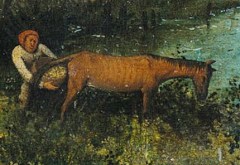
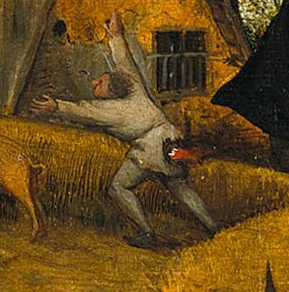
Yesterday while I was walking around the web looking at proverbs, I popped over to Wikipedia to look at their pages and found one about Pieter Bruegel the Elder’s painting Netherlandish Proverbs, also called The Blue Cloak or The Topsy-Turvy World. In 1559, Bruegal painted a village scene depicting over one hundred proverbs. Wikipedia kindly took snapshots of each scene with its corresponding proverb and meaning. One of the men is carrying daylight out in baskets, an apt image for wasting time, while another man stands behind a horse and discovers that, contrary to appearances, horse droppings are not figs. Finally, a man runs away after getting involved in a dangerous venture having learned his lesson: if your beginning includes eating fire, you will have sparks in your end.


I like to imagine that Bruegel painted the proverbs when they were still in high school, fresh-faced, funny, full of witty remarks, and sly insights. Go see for yourself and enjoy.

 Once you have learned the proverbs illustrated in the painting, watch this short animated version by artist, Martin Missfeldt.

For the love of Gordon

Standard

Proverbs prefer Twitter to blogs. They don’t have time to sit around drinking high-priced coffee at Starbucks like Essays who have the leisure to write hundreds or thousands of words about topics like “The Top Ten Ways to Avoid Unnecessary Risk.” Proverbs are words with common sense; they tweet, “Don’t poke the bear,” and then head for work. Most of them have blue-collar jobs and drink their coffee out of thermos flasks they fill at home.

On the weekends though, they will go out to celebrate a birthday or anniversary or maybe attend the wedding they thought would never happen because Gordon believes that the key to a happy marriage is a long engagement. Fewer years of marriage, he always says. Now that Gordon is seventy, Georgetta has convinced him to make his vows. So for the love of Gordon, a Proverb will pull out its good suit and new, red tie and show up at the wedding looking like an Aphorism, which is just an upper class Proverb, not to be confused with a Maxim, which is a Proverb with manners.

Hold on, I hear you saying, I beg to differ. First, no need to beg: differ away. I like to differ myself. Just remember, in a police line-up, most eyewitnesses have a very difficult time picking out the word perp.

“So, Mrs. McGillicuddy, can you identify the one you saw writing graffiti on the storefront?”

Mrs. McGillicutty twists her wedding ring. She just got married to Gordon a week ago and realizes she has just spelled her name wrong. She wonders if the police officer will notice. Then she takes off her glasses, wipes the lenses, and looks back at the officer. “Are you sure they can’t see me?”

Absolutely, says the officer, who waves at the line-up to prove his point. Mrs. McGillicuddy (who remembers this time to use double-d instead of double-t) doesn’t see two of the suspects wave back.

No matter how much time she spends looking at the Proverb, the Aphorism, the Maxim, the Saying, the Adage, the Saw, the Axiom, the Dictum, and the twins, Apothegm and Apophthegm, she can’t make a clear identification. The officer has no choice; he releases the words. They head to the nearest bar, and utter short, witty words and phrases in an effort to pick up hot-looking Quotes or Euphemisms in tight clothing.

I like proverbs, aphorisms, maxims, and all the rest. Half the time I can’t tell the difference between them, except for the twins. We Americans like the more acidic Apothegm, while the British prefer the one with the higher pH level, Apophthegm. Beyond that, they look pretty much like the rest of their relatives.

Now that I have consciously revealed my ignorance versus my normal unwitting way of revealing it, I would like to share some aphorisms with commentary.

  • A little knowledge is a dangerous thing, as you know if you read this blog.
  • Better to remain silent and be thought a fool than to speak and remove all doubt. If you have any doubts about me, keep reading this blog.
  • Count your blessings. If you’re like me, you’ll need a calculator.
  • Don’t count your chickens before they hatch because counting your blessings is enough math for one day.
  • “East is east, and west is west” can be read backwards and still make sense.
  • Familiarity breeds contempt and lots of babies.
  • Good and quickly seldom meet. I’ve tested this on my blog and it’s true.
  • Half a loaf is better than none, but it’s still a lot of carbohydrates at one meal.
  • If home is where the heart is, my home is in my chest cavity.
  • Ignorance is bliss. This explains my inexplicable happiness.
  • Let the chips fall where they may. We’ll vacuum after the game.
  • Money talks – to everyone but me.

Enjoy your day.

How much is that doggie in the window?

Standard

One of the chief delights of blogging is discovering writers, cooks, painters, photographers, teachers, and poets who delight and instruct you. One blogger who does just that is RAB at You Knew What I Meant. A multi-talented woman who also teaches college-level writing and literature, RAB draws from her collection of bloopers written by her students and comments about them on her blog. She ranges from serious and thoughtful to wry and funny. I learn something from her every day. If you go there, you will too, and you will not be disappointed.


Today I asked her to write something for my blog. Enjoy!

RAB and her younger sister: a little older but probably no wiser.

That parents would think their kids are special comes as no surprise: it seems to be part of the job description. I was blessed with parents who encouraged and supported their children while still trying to help them keep their perspective on their own achievements. But that didn’t keep my sisters and me from deciding we were, more or less, Infant Phenomenons. My parents’ smiles at manifestations of that were, I’m sure, part pride and part enormous amusement. And sometimes they also had to draw on what seem in retrospect to have been infinite stores of patience.


Here’s my most vivid recollection of one of those instances.


My sister and I were quite taken with the television show Arthur Godfrey’s Talent Scouts. Reading about it now, I find it was the #2 television hit show during the 1950s. People would come on the show and perform; at the end of the program the audience would applaud, and the applause-o-meter would indicate the winning act. Kind of like American Idol, but without the hoopla or the nastiness.


I imagine that, in what has become the pattern of televised contests, at some point in every show somebody explained the procedures and rules; but I’m not sure that anybody ever explained where the acts had come from. Helen and I reasoned that since the show was called Arthur Godfrey’s Talent Scouts, the acts must have been found by a band of talent scouts, whatever that might mean, who brought their discoveries back to Arthur Godfrey so he could put them on his show. And Helen and I formed the ambition not only to be found and brought back, but also to win the prize.


When I was six and Helen was three (and my other sister was yet to be born), my parents decided to make the first of what would be three family car trips to Florida. That was before Route I-95: they planned to drive from New Jersey to Florida on Route 1, stopping for meals etc. but otherwise driving straight through the night, alternating the driving between them. My father stowed the family luggage in the back seat foot wells and then laid a crib mattress down, covering luggage and back seat. This made a luxuriously spacious bed-cum-recreational space for Helen and me, with room for coloring books, a few stuffed toys, Weenie the sacred blanket (shreds), and bedding. There is no more magically comforting experience, I think, for a child than lying drowsily in the back seat of the family car, looking up at the stars through the back window, and hearing Mommy and Daddy conversing softly and seemingly far away in the front seat over the hiss of the tires on the ribbon of paved road. The drive down had that kind of magical peace, even when we were awake and trying to be the first to see a car with a Delaware…and then Maryland…and then Virginia…license plate.


Once in Florida, we cavorted on beaches and visited relatives and met some nice people from Michigan who were staying in the motel unit next to ours. And at some point, for some reason, we developed the plan for being discovered by Arthur Godfrey. This plan must have made the return trip from Florida to New Jersey sheer hell for our parents.


How do Talent Scouts operate, after all? Well, I knew what Girl Scouts and Boy Scouts did, having read about them and aspiring to join GSA (for the uniform): they hiked around, especially in the woods. They looked at things. They collected things. I had also read about Indian Scouts, who traveled around looking for bent twigs and other important things along the trail. So Helen and I figured that Talent Scouts probably drove the roads of America looking for talent. We were too young to have much of an idea of what went on in night clubs and the like, so it didn’t occur to us that the Talent Scouts might be traveling to look at actual ACTS. Our notion was, they kept their eyes and ears open for Talent wherever it might be—someone singing in church, somebody doing cartwheels in her yard, somebody tap-dancing with friends at school or maybe on the sidewalk. What more likely place for the Talent Scouts to be driving, we thought, than Route ONE?


Our plan was to get discovered on the way home to New Jersey. And so we insisted on riding with the windows open as we sang our best number, “How Much Is That Doggie in the Window?” It was a pretty big hit at the time, and we fancied our rendition of it quite a bit, especially the “Arf! Arf!” part. No one in a passing car would be able to see Helen’s affecting gestures of desire as we peered through an imaginary pet-shop window, but our voices alone would surely cause any Scouts worth Arthur Godfrey’s imprimatur to shout over to Daddy and ask him to pull over and let them meet the Amazingly Talented Girls. Because it was impossible to know exactly where or when the Scouts would be driving by, we of course had to sing the song over and over. And over.


My parents made the drive from New Jersey to the Florida border in exactly twenty-four hours. I’m sure the drive home was faster.


I will love them forever for never once telling us the truth about Arthur Godfrey’s Talent Scouts, or asking us to call a halt to our naïve and lusty audition.


Grown-up tattling

Standard

My husband grew up in the Midwest, Land of a Thousand Kindnesses, and came from a family who speak kindly of one another. The first time I met his parents and five siblings, I was shocked. They reminded me of The Waltons, the popular TV family of the 1970s. At family gatherings when my husband’s family told stories about one another, everyone minded everyone else’s feelings, so at the end of their stories, you expected everyone to stand up for a group hug and one more family photo.


My family grew up in Texas, sometimes, but we moved now and then just to see if growing up somewhere else would make us any different. It didn’t. We were the people from Peyton Place no matter where we lived. The soap opera known as Peyton Place first aired in the mid-1960s, shocking some and entertaining others with its stories of divorce, infidelity, imprisonment, and revenge. Just like my family, except that our show ran every day, while Peyton Place only ran two or three episodes a week. At our family gatherings when we told stories, no one worried about anyone’s feelings, we told the most embarrassing stories about each other that we could remember and ended up rolling on the floor hooting and hollering, and sometimes snorting through our noses because none of us could believe the dumb things the others were capable of.


In my family teasing has always been a sign of affection, and our favorite way of teasing is to tell on one another. When you are a child, telling on someone means you are tattling: trying to win the favor of whoever is in charge, either to look good or avoid punishment. Our grown-up tattling is after the fact and has no other purpose than to point out the obvious: we be dumb now and again. And the more we tell the stories on one another, the kindlier we feel toward one another.


So when my husband met my family, he was shocked. It didn’t dissuade him from marrying me, however, because I made sure we were already married before he met them. (Note to reader: Contrary to what my family says, I’m not as dumb as I look and sound.)


If, in the telling of a story about a sibling, we see signs of embarrassment or hear attempts to explain or justify, that story will become a signature story, one we will tell again and again, every chance we get. Because that’s what love does.


My mother never took part in any of this teasing. Of the four siblings I grew up with, only two of us shared the same father. The other two had their own fathers, yet we all share the same sense of humor. Maybe mother was merely the carrier of the slightly off-kilter humor that manifested itself in her children.


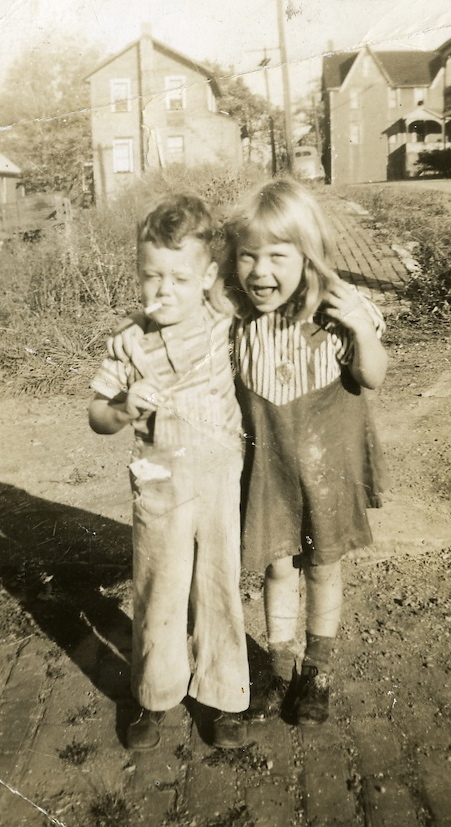
Of course everything I have written up until now is just an excuse to tell on the two siblings that I know are still alive. One of these posts I will explain more about my known and unknown siblings. But until then, here’s me showing some love to my brother and sister.

My brother in a littler time

Brother story

Until my brother came along ten years after me, I was the baby of the family. Mother indulged him not only because he was the youngest, but also because he was a boy, something I had been expected to be, but failed. When he was five years old, we lived in military housing in Fort Wainwright, Alaska. One day when he was shopping with mother at the commissary, he asked for some strawberry preserves. Mother tried to talk him out of it and told him he wouldn’t like it because it had chunks of fruit inside, but he insisted. The next day she put the preserves on his peanut butter sandwich, and after one bite, he knew mother was right: he didn’t like preserves. Mother insisted that he eat the sandwich, and then left him alone in the kitchen. He pulled the two pieces of bread apart, thinking he might be able to salvage the peanut butter side. It, too, was ruined. I’m sure that we had a garbage can in the kitchen, and I know that my brother had seen people throw things in the garbage, so it wasn’t as if he didn’t know how to dispose of the bread. He must have feared that mother would see the uneaten sandwich languishing in the trash, so he did what any reasonable person would do. He picked up the rug in front of the kitchen sink, placed one slice of the bread on the floor, and carefully covered it with the rug so that it was hidden. Then he took the other piece, opened the basement door, and flung it down the stairs. After all, who would think to look there? He doesn’t remember if mother found the first slice before or after she stepped on the rug; he can’t remember any consequences at all. Since he was the youngest, there probably weren’t consequences.

One of the few days the world left my sister's hair alone

Sister story

As a young girl and teenager, my sister suffered from Tourette’s of the Hair. Most nights she lathered her hair in Dippity-do, wrapped the strands in pink pokey, plastic rollers; large, bristly, netted curlers; or soft, spongy snap-ons in the belief that she could make her hair bend to her will. More often than not, it didn’t. Some nights the hair wriggled out of the curlers; other nights the curlers twisted the wrong way. When she commanded it to flip up, it flipped down. Or if she ordered it to swoosh that way, it drooped the other way. This made bad words come of her mouth. She developed two theories based on her hair. First, she believed the world had an interest in how her hair turned out each morning. Nice hair displeased the world; it was completely and utterly against her quest to be the best tressed at school, and, in fact, wanted her to go to school with failed hair. Second, she convinced herself that the answer to obedient hair resided in the bathroom counter. She hypothesized that by striking the counter hard enough and often enough with a comb, brush, or curling iron, her hair would suddenly flip or swoosh the right way. It took a number of years and a pile of broken hair appliances before she accepted the fact that the counter was merely an innocent bystander. She told me later with some regret that she passed this problem onto her daughter. She is still working on the problem of the world being against her.

In the interest of fairness, I should include a story about myself. Unfortunately, I have run out of space. Really. If I write any more I will bump into those little icons under this sentence.

Love in the time of garlic

Standard

The picture of Saint Valentine, patron of lovers, depicts him with birds at his feet and roses at his side. Geoffrey Chaucer is responsible for the birds. People in the Middle Ages believed that birds chose their mates in the middle of February. In his Parliament of Foules, Chaucer wrote: “For this was on seynt Valentynes day/ Whan every foul cometh ther to chese his make” (309/310). The spelling looks remarkably like that found in modern text messages and e-mails. To comfort myself at night, I tell myself that young people are not bad spellers, they are merely returning to Middle English, the language of Chaucer.


We can hold the Greeks and Romans responsible for the roses at Saint Valentine’s side because like Chaucer they are not here to defend themselves. Many of their stories about the god of love, Eros to the Greeks, Cupid to the Romans, included roses.


If I could embellish the saint’s picture, I would have him hold a box of dark chocolates in his right hand and next to the roses plant some stinking roses, an affectionate name for garlic. For me, love isn’t love if it doesn’t smell of garlic.


Part of the attraction between my husband and me is the love of garlic. For our anniversary a few years ago, we bought one another garlic presses. He was traveling and had to spend several months living on his own. How could I send him out into the world without a garlic press? The one we had at the time was old, so we went to a kitchen specialty store and shopped together. He looked over the presses and chose a conventional one that crushes the garlic, while I dithered over the deluxe model that could crush or slice, even at the same time! In spite of the high cost, he bought it for me. If that isn’t love, I don’t know what is.

No matter how you slice it, this garlic press proves my husband has a crush on me.

Over the years we have met people who do not or cannot eat garlic. We understand those who cannot eat garlic, but not those who choose not to. We will still love you if you don’t eat garlic, but we will probably talk about you behind your back.


“Gert is coming over for dinner, honey, so we can’t use any garlic.”


Look of consternation. “Does she have a doctor’s note?”


Look of surprise. “You know I forgot to ask. She looks so honest, and she said it upsets her stomach.”


Later that day on the phone. “Hi, Gert. About your allergy to garlic. My husband and I were wondering, do you have any kind of documentation? It’s not necessary, of course, but if you have some, we would really like you to bring it with you tonight when you come over for dinner.”


Tonight, in honor of St. Valentine and his name, which comes from the Latin valens meaning strong, powerful, and healthy, I plan to make something strong, powerful, and healthy: Death by Garlic pasta. You can find a number of recipes online, but go here to find a simple one that uses 10 cloves of garlic. If that sounds too wimpy, or you have a fear of vampires, or you are feeling particularly romantic, you can double the amount of garlic and fall in love twice as hard. Otherwise, just cut a clove of garlic and rub it behind your ears and on your pulse points. If your husband is anything like mine, he will do anything you say.


If you are still wondering what to buy your loved one for this special day, remember that while flowers and chocolates are always welcome, nothing says Valentine’s Day like the fine bouquet of the stinking rose.


Leitwortstil

Standard

Let’s be honest, leitwortstil looks like something you order at the deli. “I’d like a pound of the best wurst you have, two pounds of un-holey Swiss cheese, and half a pound of leitwortstil.”


Now, for the sake of fairness, since we have been honest, let’s be dishonest. Or rather, let’s be imaginative and fictional and say you make this order at a word deli. Afterwards, you go home and write a story in which you make the protagonist eat “best wurst” and “un-holey Swiss cheese” meal after meal because that’s what leitwortstil does to you.


When Germans try to say “leading-word style” in English, it comes out sounding like leitwortstil, so we must learn to deal with that. This is a good reminder to English speakers to make sure to be the first ones to say new words; otherwise, we will be stuck with words that are hard to pronounce, like Schadenfreude and Fahrvergnügen. Leitwortstil, which should technically be capitalized since it is a German Noun, is the repetition of certain words or phrases in a story or body of work that the writer uses to develop a motif or theme. In layman’s terms, think of it as the “Are we there yet?” refrain that a child repeats over and over on a cross-country car trip, which helps establish the theme of your family vacation and ultimately your life: madness.


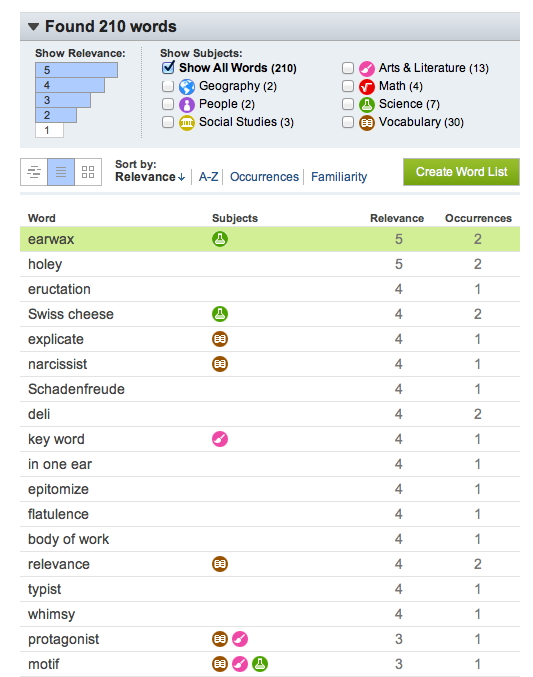
Although I am only a typist, it occurred to me that perhaps I have unwittingly or possibly half-wittingly employed leitwortstil on this blog. This led me to VocabGrabber, a website that allows you to enter a text and sort the words by relevance, occurrence, and familiarity. In addition, words are marked in seven categories: geography, people, social studies, arts and literature, math, science, and the puzzling category called vocabulary. You can imagine how helpful a website like this if you need to waste several hours of your life.

In a desperate search for my leitwortstil, I began copying and pasting my posts into VocabGrabber and made three important discoveries. First, the two words I repeatedly repeat are “are” and “have.” My literary style of typing brings truth and light into the world by explicating and complicating the two basic human needs: existence and possessions. As Descartes might say if he were still alive and we were both yearstricken: we are, therefore we have.


The second important discovery came when I entered the text for my blog about joining the pantheon of the blog gods. Overcome with whimsy, I clicked on the relevance button, which VocabGrabber declares are the words “most significant for the average reader.”  In that post. the most relevant word to you, dear reader, is earwax, a word lodged in your mind and ears in a strikingly relevant way. And right after earwax, I discover that eructation is important to you, followed by narcissist, key word, epitomize, and flatulence.


For research purposes and because I have wasted so much time at VocabGrabber what is another ten minutes, I typed in all of the above paragraphs. You still find earwax the most relevant, followed by holey, eructation, Swiss cheese, explicate, and narcissist. You people surprise me. I had no idea these things meant so much to you. I did notice that you are not having as much trouble with your flatulence today. I’m happy to hear that, or not hear that if you know what I mean, and I’m sure the people around you are too.


My third discovery daunted me. VocabGrabber reveals more about word usage than leitwortstil, so I must continue my quest. And it reveals more about you than you may have wanted me to know. I will try to use this knowledge wisely. Your secrets are safe with me.

Listening to your eyes

Standard

Sight seems simple enough. First, you open your eyes. If the room is dark, you go back to sleep. If not, the lenses in your eyes focus. If your eyes find this difficult to do, your nose offers to hold your external lenses because it, too, would like to get a better look at what is right in front of it. Photons of light, like tourists hurrying off the bus, rush into your eyes to see your retina. They crowd around the retina while the brain takes their pictures, and then they rush out, so the next crowd can come in. Some of the same ones visit every single day. Apparently they have nothing better to do, or perhaps the retina is worth seeing again and again.


The brain collects these photos from morning till night, ignoring the most familiar, studying the unfamiliar, and sorting them into piles of those it likes and those it doesn’t. But what is the point of taking pictures if you don’t have someone to share them with? So, the brain shares them with the heart and that complicates sight. Hearts may be born with 20/20 vision, but over time they can change. Life can scar the lens of the heart and pressure can change its ability to focus. An astigmatic heart can’t see clearly, and looking through the lens of expectations only makes it half-blind. Even with the corrective lenses of a friend, lover, or family member, some things remain distorted, blurry, or impossible to see.


If the heart insists loudly and persistently enough that its way of seeing things is true, the brain can start believing the heart instead of the eyes. And the heart is often right. The eyes need light to see; the heart sees in both the light and the dark and can feel truth even when she can’t see it.

But sometimes the heart isn’t right. You come to a crossroads and see a sign telling you where you are. The heart reads the unfamiliar script, not even sure how to pronounce it. Lost again, she says. One more sign of failure. Everyone, except me, knows where to belong. I will never find my way home now. The eyes, however, see the bright, bold letters, the flourishes around the words put there by some sign painter writing his heart in simple words for the weary traveller who would surely walk this way and need some direction. You are here. Just follow the sign. A place of rest lies up ahead. This road might be the one that leads you home.


This time the eyes are right. The heart must trust and follow.