Who am I?

Standard

I don’t know who I am these days. I have been married to the same man for over 30 years, and he thinks he has been married to the same woman for the exact amount of time. (You’re not going to believe this crazy coincidence: we both got married on the same day!  Just one more sign we were meant for each other.)


I have always thought of myself as a small woman with a talent for getting older. Although I have not always liked who I am, I haven’t doubted who I am. Until now.


We don’t have cable TV, partly because we don’t have that much time or interest, and partly because we are more interested in saving our money. But sometimes when I exercise on the treadmill, I go to hulu.com to watch a TV show or documentary on my laptop.


Hulu features hundreds of old programs and many episodes of current shows. I have walked through miles of Alfred Hitchcock Presents and the Alfred Hitchcock Hour, along with a lot of other shows. Sometimes I watch the ads; other times I take my headphones off.


Recently, while watching a show, a Weight Watchers ad came on. Jennifer Hudson smiled at me and belted out, “You are me and I am you.” I looked down at my plaid pajama bottoms and green sweatshirt, then looked back up at Jennifer in her form-fitting black top and tight pants, compared my clunky white running shoes with her open-toed stilettos, and said, “Okay.” I continued belting out that song, while Jennifer slogged forward on the treadmill, and then I disappeared. When the show came back on, we switched places again. It was weird, but then I’m used to weird.

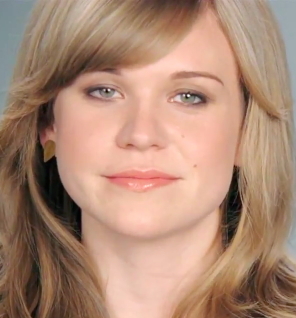


The other day, instead of Jennifer (who is me and I am her), a young blonde woman smiled at me and said, “I am you.” But before I had a chance to be her, a young brown-haired woman smiled at me and announced, “You are me.” That was beyond weird.


Needless to say it left me shaken, but not stirred. I feel like Jackie Chan in the movie Who am I? I sure hope I’m not him. I’m not up for all those action movie stunts.


I have to be one of four women, but I have no idea which one I am or which one is sleeping with my husband. Should I ask him? Should I contact Weight Watchers and ask them to send me home? Should I change my gravatar picture?


I had no idea that on Weight Watchers you lost not only weight but also your sense of identity. Will I have to join in order to find myself? I’m starting to miss me. Should I be alarmed that one of the anagrams for Weight Watchers is “Wager the Switch”? Or should I focus on the other anagram, “Great with Chews.”


I need help people.


(Note to Weight Watchers: I borrowed these pictures from your ad, and I’ll give them back in exchange for you know who.)
When chocolate disturbs

Standard

I like chocolate dark, three taste buds shy of bitter. One small bite and I start getting messages from my brain saying, “Thank you,” and “More, please.” As food, it delights my tongue, and as medicine, it soothes my brain.


I have liked chocolate since I was a small child and discovered that the Easter bunny laid small chocolate eggs in my Easter basket. I later learned that rabbits do not lay eggs; they do, however, extrude something that is eerily similar to little chocolate pellets. I lived with that disturbing juxtaposition of ideas for years, but eventually got over it and continued trying to consume my allotted 11.64 pounds of chocolate each year. That’s how much each American averages. The Swiss eat almost twice that. Clearly, I was born in the wrong country.


http://www.flickr.com/photos/wheatfields/2310156154/


As an adult I have lived a relatively undisturbed life as far as chocolate goes. However, these last few years, an uncomfortable truth has been knocking on the door of my brain. It has pamphlets, which is always a bad sign. Opening the door means I must listen to a prepared speech, sign a petition, and probably donate some money. Maybe even the money I would use to buy chocolate.


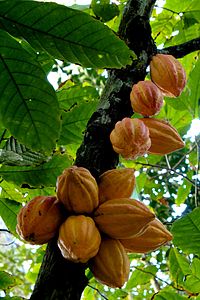
For me, the best chocolate has at least 70% cocoa. That’s the ingredient that has so many health benefits, including helping to protect my heart. Cocoa makes my brain happy; and like so many gifts, it grows on trees.


The cocoa plant is delicate, especially when it is young. It requires attention, care, and nurture to develop properly. If a plant is tended carefully, it can start bearing fruit when it is four or five years old and produce for several decades.


Cocoa plants sound a lot like children, don’t they? Children need care and nurture to grow properly, too. And that’s the problem. Many cocoa farms employ children, and some farmers enslave children, making them work 12 hours a day without pay or much to eat.  At night, the children are locked up. If they try to run away, they are beaten.


I don’t want to eat chocolate that has someone’s childhood as its main ingredient. No amount of sweetener can make that kind of bitterness palatable. And if I know that the price on my candy bar is low because some children are forced to pay the real price by spending their childhood enslaved on farms, no amount of inexpensive chocolate is going to make me happy. My tongue doesn’t mind at all; it likes chocolate no matter what, unlike my brain, which has nothing better to do than gossip with my heart.  Once my heart gets involved, the two of them always insist that I do something.


Refusing to buy chocolate might make me feel good, but that’s about all it will do. It won’t help the thousands of smallholder farmers in West Africa, Indonesia, Brazil, and Ecuador who grow cocoa. They deserve a living wage; however, they receive only a pittance of what I pay for chocolate. Some of these farmers resort to forced labor to make growing cocoa worth their while. If I’m going to enjoy eating chocolate, I can’t ignore these facts.


Ignorance is bliss until it isn’t. Now I have to pay attention, read labels, and check up on the companies I buy from. I have to sign petitions. And I have to pay more money for chocolate that doesn’t have “essence of childhood” as an ingredient. But I don’t mind because then I can start listening again when my brain says, “More, please.” And it will make my heart happy again in more ways than one.


To see the places I have been that knocked the bliss out of my ignorance, go here, here, here, and here. To see the places my heart and brain conspired to send me, go here, here, or here to see what people are doing about it.


(Chocolate kisses go to Wikipedia and <http://www.flickr.com/photos/wheatfields/2310156154/ > for the pictures.)

Why I type

Standard

My laptop has a keypad lock that opens up a vault. Inside there is a labyrinth of rooms; and in those rooms: stories, poems, and word-hoards.


I type to get inside.


Some people know which keys to press. They spend their years alone and learn the secret sequence. Their fingers type until the doors crack open; then they step inside. When they return, their arms are full of stories. Others tap, tap, tap so lightly and open doors to poems.


Any combination lets you in that first door: an antechamber full of prose and verse. In that dim light all words glitter, enough to make you think they’re gold. I’ve been a fool and dragged more than a few out in the light and found them only brass.


Farther in, the light grows faint and you wander in a maze where every door is locked. No one can guarantee the doors will yield.  You walk by faith, not sight. I’ve stumbled into doors, heard the murmurs of the words, but failed to get inside.


I’m baffled by the combinations.


At night I dream of permutations and wake up full of simple faith. Stories and poems wait in that many-chambered place. So day after day, I type and hope that I can open doors. I want to find those words I’ve heard so much about.


Remembering dreams

Standard

My dreams are back, those stories I tell myself at night. I don’t believe the stories ever left, but for most of the last four or five years, I have woken up with no remembrance of my dreams.


For years I wrote down my dreams in the back of my journals. My day-time thoughts began on the first page, my night-time thoughts began on the last page, and each moved toward the other, claiming pages until the book was full.  It seemed fitting that my dreams were hidden in the back, behind my more lucid thoughts.


On Tuesday night I dreamt about a good friend in Japan. I still carry some of the joy of seeing her again, if only in my brief dream. My emotions don’t seem too concerned with the fact that I didn’t actually meet her face to face. It must be like this when a mind is in decline. People are forgotten, the world grows strange, but the emotions are remembered, as familiar in this singular reality as they were in the shared reality of the former life.


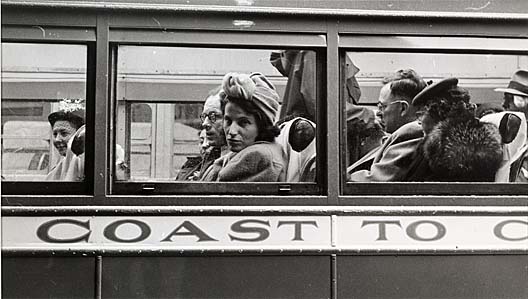
Before the world spun me old, I lived as a young woman. That was decades ago. I remember dreaming that I was old and was riding a bus through an unfamiliar city. I sat next to a window and watched the world go by. When the bus stopped at a light, I saw a good friend standing on the street, still her young self. When our eyes met, we both smiled and, for a long moment, I couldn’t tell who I was or whose dream it was. Was I an old woman dreaming about her as a young woman, or was she a young woman dreaming about me as an old woman? When the bus stopped, the doors opened and I got off in the room of morning light where I lived life.


For the last three nights, I have remembered the stories I told myself in dreams. I stopped journaling three years ago when I lost my words. Writing this blog has helped me find them again. Maybe that’s why my dreams came back.

◊ ◊ ◊ ◊ ◊ ◊ ◊ ◊ ◊ ◊ ◊ ◊ ◊ ◊ ◊ ◊ ◊

Photo courtesy of Smithsonian American Art Museum, Museum purchase made possible by Mrs. Alexander Hamilton Rice and Linda Adair Miller <http://americanart.si.edu/collections/search/artwork/?id=32331&gt;

When trees come back

Standard


Trees believe in reincarnation. After they die, they lumber back into our lives as boards, books, and toothpicks.


Trees spend their lives holding out their hands to birds, calling them to perch or rest. In their second lives, trees come back as chairs, inviting us to sit down, offering an arm to grip, attending to our conversations without remark, and sharing in our silences. At night, we nest in tree-made beds, hatching dreams like eggs.


In their first lives, trees provide banquets for the birds: beetles, ants, and caterpillars. When they return as tables, we flock to them and find the food and wine that fill the house with love and laughter. And we keep their perfect splinters in a jar to pick our teeth.


Some trees become the bones of houses, use their strength to keep the roof over the heads of all who have forgotten them. Others are the doors of daily life, sliding, slamming, creaking, opening, shutting us in and out. They make a place of quiet for one and provide the lock that opens love for two. So many secrets hinge on them.


Trees write the world’s story on their leaves. In fall they send the pages down, though few will stoop to read them. They tell the tale every year as if it were the first time. Coming back as books, they do the same, waiting on the shelves, leaves and leaves of stories falling into minds who stop to read them. And every telling new.

Trees who spend their lives trying to catch clouds come back as poles to hold the wires words squeeze through. A hundred years ago or more, people spoke with patterned sound, tapping news of wars, births, deaths, and regrets, like birds tapping on the bark of trees.


When taps and codes were not enough and people phoned their voices, the wires sang and hummed with promises and lies, rang with jokes, the murmured shame, or disconnected lovers; a goodbye click, the end of every story.


These unleaved trees with straightened arms, stand without a whisper, yet call out to the birds, who return, like acrobats with wings, to balance on their wires. In that other life, when poles were trees, they learned the art of listening from crows complaining of the rain and winds whispering of angry clouds to come.


Fewer voices travel on the wires now, but these poled trees do not complain. They shoulder power to brightens our lives as they once carried the luster of sun on their shimmering leaves.


When trees return a second time, they hold us, shelter us, offer us a place to lay our heads, bear the words that tell our stories, give us room to live, shut out the world of noise, and listen, always listen. When trees come back, they yield to our sharpness and our desire to measure and control. In the quiet, when we leave the room, they dream of rain, wind, and bird song; each tear falling softly as a feather on snow, lost by a winter bird in flight.


Sentimental swoons

Standard

Sentimentality is one of the nicest pejoratives you’ll ever meet. Maude, as I call her, cries easily, regularly rams into icebergs of emotions that sink her unsinkable optimism, sending her to the bottom of the ocean, but not before she can remember her happy childhood when every flower smelled of heaven and housed a butterfly, and house-trained robins fluttered above her head, leading her safely home where she lived happily ever after. She always manages to escape or resurrect from her watery grave and dry off her emotions, just in time to plan her next voyage across the sentimental seas. She calls every sailing vessel the Titanic, closes her eyes or changes the channel when the bad parts of life come on, and always thinks in pink. Even her sunglasses are rose-colored.


The Titanic (photo from Google)


However, Maude wasn’t always a pejorative. She was the darling of philosophy and literature in the 18th century; she looked more attractive when she was younger. During much of the Age of Enlightenment, Sentiment had to eat in the kitchen, while Reason sat at the formal dining table entertaining scientists, philosophers, and writers. After a while, Sentiment got tired of eating the leftovers and seduced the master of the house. When she sat down at the formal table and poured her wine, the conversation turned to discussions about subjectivity, introspection and her role in developing a moral sense. Sharing the table was one thing, but now Reason, long used to hunting alone, had to take Sentiment with him when he went out looking for moral truth. Reason always fancied himself the better shot.


Not-so-stern-looking Laurence Sterne, author of The Sentimental Journey, a sentimental novel. (Photo from Wikipedia)


Maude appeared in many of the novels of that era, using her beauty and brilliance to appeal to the reader’s emotions. After loosening the reader’s hand from the grip of cold logic and reason, she grabbed it and took the reader with her as she supped with sorrow, fought off lascivious brigands, and succumbed to both love and terror by swooning. Carried across the stormy seas of emotion, battered and bruised, now aloft on the crest of a wave, now almost drowning in its trough, the reader arrived at port, armed with a moral compass to find his or her way safely home. It was the only way Maude knew to teach the reader how to live nobly and morally. Ever the heroine, she drowned or died in story after story, the consequence of being too good for this world. She always showed up for work again the next day, ready to teach someone else.


Modern and post-modern readers who have grown up eating irony-fortified cereal for breakfast usually feel seasick after riding the high waves of sentimental novels from that period. Maude’s excesses led inevitably to parody and ridicule. She moved out of her manor, where she had entertained well-bred friends with refined sensibilities, and bought a house in town, next to the used bookstore. You have probably seen her shopping at Wal-Mart; the prices make her swoon.


People who write capital L literature want nothing to do with Maude. If she appears in your story or poem or essay, critics will label your writing sentimental, and they will use a sneering font on the label. As you know, labels written in sneering fonts are almost impossible to remove, so you can forget your dream of obscure fame in literary journals. Oh sure, there’s always the New York Times best-seller list, but do you really want to end up like Nicholas Sparks?


It’s probably too late to try to clear Maude’s name, no matter how much we may like her. I’ve noticed that she often uses her first and middle name these days: Maude Lynn*. She was never one to show restraint, any more than I do when it comes to puns. She chose a life of excess; that’s why a lot of people won’t make eye contact with her. I think she will always be popular, maybe not with the big L people, but with people who don’t capitalize their literature. I feel a certain amount of sympathy toward her, but I don’t like it when she glosses over the hard truths or pretends they aren’t there. I don’t like it when she takes the shortcut to happiness, to avoid the winos, addicts, and broken people who hang out at the bus station downtown.


I would like to live in a world with fewer problems; a world where every broken person is fixed. But as much as I would like to get to happiness faster, today I am not going to try to get there with Maude. I am going to go downtown and take the bus instead.


(*Note to reader: Gratuitous puns found on this blog are the result of an almost imaginary medical condition. Try not to judge.)

When proverbs were young

Standard


When you grow up in a city or town, you see the streets, houses, businesses, and other landmarks so often, that after a while, you hardly notice them. The commonplace bores you.


Languages are like cities. Throughout the day, your ears travel through streets lined with familiar phrases, idioms built of ancient brick, and housing tract after housing tract of clichés. Your ears can get as bored as your eyes.


When you travel to another city or language, whether for a visit or to live there, nothing bores you. That maple tree looks no different from the trees at home, but here in this new setting, standing there in front of the yellow house, sheltering the red bench, it enchants you. As the late afternoon light shimmers on the leaves, you take picture after picture, hoping to capture its beauty.


And once your ears adjust to living in a new language, you find simple words and phrases, shortcuts that help you bypass paragraphs of thought and lead you straight to what you want to say. You find yourself wandering down a street in Japanese, feeling the wind blow softly, soyo soyo (そよそよ ) and you almost skip because now you know how to name the sound of a soft wind. Then when the wind dies and the noises cease, you hear the sound of silence, shiin (しいん) and begin to hear that silent sound everywhere. All of the new words delight you, and you are surprised to learn that some of the famous landmarks in this new city are considered clichés by the people who grew up in the language.


I have spent some time living in and traveling to other languages, and I teach English to students from other countries, so I know the delights of hearing words for the first time and falling in love with them.


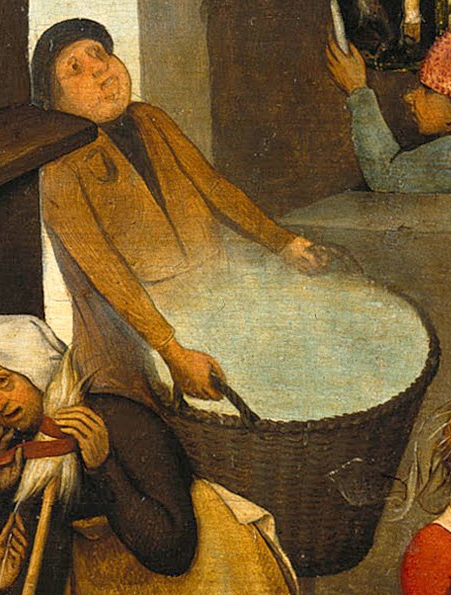
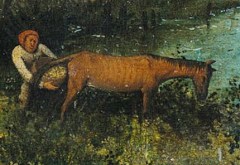
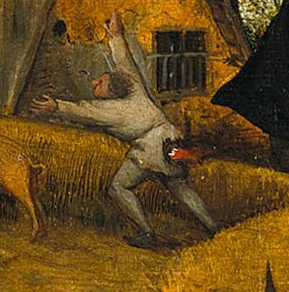
Yesterday while I was walking around the web looking at proverbs, I popped over to Wikipedia to look at their pages and found one about Pieter Bruegel the Elder’s painting Netherlandish Proverbs, also called The Blue Cloak or The Topsy-Turvy World. In 1559, Bruegal painted a village scene depicting over one hundred proverbs. Wikipedia kindly took snapshots of each scene with its corresponding proverb and meaning. One of the men is carrying daylight out in baskets, an apt image for wasting time, while another man stands behind a horse and discovers that, contrary to appearances, horse droppings are not figs. Finally, a man runs away after getting involved in a dangerous venture having learned his lesson: if your beginning includes eating fire, you will have sparks in your end.


I like to imagine that Bruegel painted the proverbs when they were still in high school, fresh-faced, funny, full of witty remarks, and sly insights. Go see for yourself and enjoy.

 Once you have learned the proverbs illustrated in the painting, watch this short animated version by artist, Martin Missfeldt.

The key to increasing your readership

Standard

Yesterday morning was a dark and stormy night that found me in a twist of strange fate. On the way to untwisting it, I discovered the key to increased readership! Yes, it’s true; I have another secret to reveal to the world. And once again, I am providing it free of charge. Second because I care about you. First because I tried selling you Dog and a Half word kits and you ignored me. How sad is that? Sad enough that I couldn’t even put it first.


My morning routine seldom varies: up at 4:30 a.m. for first dose of medicine (p.o., Latin for “per os” meaning “by mouth”); ingest ½ cup of granola, followed by reading/internet time; second dose of medicine, as needed; and finally, morning typing time.


The dark and stormy night started with the typing. The more I pushed on the keys, the more I felt like I was pushing on bruises in my heart. I tried typing softly, but it kept hurting. Certain keys produced  tear drops, which as you know can mess up your computer. So, I stopped and felt better and saved my laptop. It’s what I do.


Are you a Freud of psychoanalysis? (Image courtesy of Wikipedia.)

During my time at work, my fate remained hideous kinky, which, if you know anything about the movie of that title, has Freudian connections, much like my life. When I left school late yesterday afternoon, I barely got home before night fell. Thankfully I got there first, and watched through the picture window as the darkness crashed down.  Safely ensconced in my recliner, I opened my laptop, only to be gobsmacked. Yes, smacked right on the gob!


Fast backward. A few weeks ago, my blog was in an accident. WordPress reported it on their front page, so a lot of people came over to see it. Most, of course, took one look, felt disappointed, and left. Over the next few days, some came back, but eventually the onlookers tapered off. The graph below tells the sad, sordid story.


Fast forward. Things returned to normal, I produced wreck after wreck, but not very gawk-worthy.


Pause. Sorry, this is a gratuitous use of language. Somehow I got stuck in this tape recorder image.


Play. We left off at the gobsmacking. When I checked my stats last night, I had almost as many views as the previous day. The only difference was that I hadn’t posted anything. This morning I see that the day I didn’t post, I got more views than in the previous five days when I did post. You need a magnifying glass to see the difference, but trust me, the orange arrow non-posting day has more views.


Can you imagine my excitement? I have discovered the key to increased readership: Do Not Post! It seems counterintuitive, but all new discoveries appear that way at first.


Oddly, I must post today in order to share this information with you. However, because I am posting it, you probably will not read it. I am like Hamlet, or since I am female, Hamlette, pondering whether to post, or not to post.


I hope this helps you. I have more to say, but it will have to wait for a day I don’t post. I certainly hope you come back then.


You wanna speak-a like me, you gotta affix your words

Standard

You may already know that I am like an Italian cosmetic surgeon for words. When I lived in Italy, I picked up a lot of the language. In fact, I picked it up three times a day for three weeks because it was written on all of the menus. Since I only lived there 21 days, you’d be surprised at how much I learned. Other Italian speakers are.


I don’t want to show off and use any more of it than I already have in the title of this post.


When I’m not being humble, I like to be generous. And although it is extremely difficult to be both on the same day, I’m going to attempt it.


Today, I want to share with you some of the intricacies of word-building, so that you, too, can affix words.


Let’s start with some vocabulary:


Base word: The lowest form of a word.*


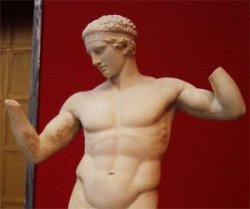
Sometimes "give me a hand" is meant literally. Hard to grasp, isn't it? (courtesy: http://www.squidoo.com/polykleitos-diadoumenos)

Prefix: Pieces broken off of Greek and Latin words that go on the front of a word to help it say something. Think of them as the missing hands from all of those Greek and Roman statues. When a word is in need of  a fix, you lend it a hand.


Suffix: More broken word parts, but these are placed on a base word’s backend. (NOTE: This requires the utmost delicacy or the word will say something you weren’t expecting.)


But first, let’s clear up a potential source of controversy: Why do I call the base word the lowest form of a word? One word: Samuel Johnson. In 1755, he published a dictionary, unexpectedly called A Dictionary of the English Language. He took nine years to define, research the origin, and give examples for the 42,773 words in the dictionary. In this scholarly work, he included some clever definitions, such as:


Lexicographer: A writer of dictionaries; a harmless drudge that busies himself in tracing the original, and detailing the signification of words.

Oats: A grain, which in England is generally given to horses, but in Scotland appears to support the people.

To worm: To deprive a dog of something, nobody knows what, under his tongue, which is said to prevent him, nobody knows why, from running mad.

How can you not love a man who puts things like that in a dictionary? And what’s not to like about someone who calls himself a harmless drudge? Yes, I know that Ambrose Bierce published his witty definitions of words in The Cynic’s Word Book, later retitled The Devil’s Dictionary, but Johnson sprinkled his wit into a dictionary that was the standard for the English language until the OED (Oxford English Dictionary) came along and started showing off. Just as computer geeks plant easter eggs in programs, Johnson planted surprises in the dictionary to delight word lovers.


Samuel Johnson said, "A man seldom thinks with more earnestness of anything than he does of his dinner." (Portrait from National Portrait Gallery London)

For reasons not yet revealed to me, I am obsessed with Samuel Johnson, his work, and his remark about puns as the lowest form of humor. With that in mind, consider: Johnson compiled a dictionary full of base words. From these words he created jokes. Ergo, ipso facto, base words themselves are the lowest form of words.


If you are like most people, that will not make perfectly good sense to you, but I’m hoping that you are not like most people. You are, after all, reading this blog.


And now, you must accept my humble apologies. Two hours of humility is my limit; it has exhausted me. I must spend some time thinking about dinner.  Tomorrow I will be generous and teach you how to affix words.

A name by any other name

Standard

Texas' most famous Hogg - Governor during the 1890s (photo courtesy of Wikipedia)


If you are from Texas, you already know about Governor Hogg and his daughter. Before Hogg, governors had to be brought in from out of state; he was actually born in Texas and served during the 1890s. I heard about him when I was a very young child and immediately loved him because he named his daughter Ima. At the time, I didn’t consider how Ima felt about it; I just liked the sound of it. When I heard he had another daughter named Ura, I wished that my parents had loved me enough to name me Ura Hogg. Later I found out that Ura didn’t exist. I have lived with a broken heart ever since.


I can’t trace my love for wordplay to the story of Governor Hogg, but it definitely taught me that people’s names are fun to play with. (Note to reader: I am doing my best to stay away from pig puns. With a name like Hogg, that’s hard to do. But for your sake, I will gird up my tender loins and get out of this paragraph as fast as I can.)


Here’s what got me to thinking about Hogg. Yesterday, we saw a car with a license plate from Iowa. From deep within my brain, a wish came bubbling up; a wish that my last name was Lott and that I was from Iowa. Then my online name could be Iowa Lott.


The lovely Ima Hogg kept her name all her life (photo courtesy of Wikipedia)

In the privacy of my own mind, I do this kind of nameplay all of the time. I once worked with a woman whose last name was Mennen. When she told me she had a grown daughter, I was quite excited. Before I could offer to be a matchmaker, she told me the daughter was already married. I dreamed of fixing her up with a man named Black. She would use a hyphenated last name: her maiden name and her husband’s last name. I imagined her wearing Ray-Ban sunglasses and a black suit to work. When people asked her name, she would answer simply, “Mennen-Black.” Had I been more careful about who I married, I could have had a name like that.


There’s more, of course, but today is the first day of classes for this semester and I need to get there early. I always look forward to my classes. The people sitting in those chairs are not just students to me, they’re names.