Twee

Standard

Words are like people. Some of them look alike because they come from the same parentage. Both “sanguine” and “sanguinary” are adjectives and were born from sanguis, Latin for blood. So, after learning that a sanguine person is cheerful or optimistic, you might run into the word “sanguinary” while reading a text, look at its ruddy face, and expect it to tell you a joke or recite an inspiring quote. Don’t be surprised if it pulls out a knife and threatens you. The only thing it’s cheerful about is bloodshed and cruelty.


Other words, like the nouns “desert” and “dessert” look so much alike, people can hardly tell the difference. If you look closely, you’ll see that “dessert” looks more curvaceous. It’s that extra “s” in the middle. They’re not related although both words have ancestors who came from the Latin. Other than that, the only similarity is that desert is a waste place, and dessert goes to a waist place.


The other day I ran into “twee” online. It was modifying a noun, music, and speaking in a colloquial accent telling everyone who would listen that the music was sickeningly sweet.  I’ve heard it say things like that before. It also has the remarkable ability to make bird sounds. You may have heard it imitate the wren by saying twee-twee-twee.


1916 cover (Wikipedia)


Twee in its original sense of sweet or dainty first appeared in print in the British magazine, Punch, around 1905. Someone heard a children pronouncing “sweet” as “tweet,” then took the word and dropped the “t.” It was the linguistic form of stealing candy from a baby. Now it disparages music and people by calling them mawkish or overly sentimental.


I like how the word sounds. Twee rhymes with glee and whee, words of enthusiasm and joy. I’ve heard birds chirp it, and I’ve had small children answer “Twee” when I asked their age. Elmer Fudd climbed twees looking for that wascally wabbit, Bugs Bunny. “Be vewy, vewy quiet, I’m hunting wabbits,” he used to say. Twee is a word that fits in your pocket, a small joke of a word, a word with punch.

 

When sister was twee, she stood front of a twee. You can almost hear the birds singing, "Twee, twee, twee."


Even though the masters of irony and sophistication have forced twee to make disparaging remarks about other people, I won’t abandon it. That’s just its corrupted twin. Elmer Fudd and I know the real twee, and any word that is a friend of birds, Elmer, and three-year-olds is a friend of mine.


Portrait of Elmer J. Fudd courtesy of Wikipedia.


More flounce

Standard

Flounces made of words. Dress is duct tape and pages from the telephone book. Source: The Jolis Paons Flounce Dress


Jenny saw snow for the first time a few months ago. She came to Wisconsin from Central America with a dozen other students to enter a two-year program for agricultural development.


The students have had one semester of intensive English; and now, in this second semester, they have a mixture of program classes and English classes. Jenny is in my reading class.


At the beginning of the semester, I asked each student to write personal goals for the class. Be specific, I told them. Don’t just say you want to improve your reading ability; tell me how many books you are going to read each month.


Most of the goals were specific, but a few general ones slipped by. My favorite came from Jenny. “I want more flounce in my English,” she wrote.


Jenny’s first language is Spanish, so when she wrote the word “flounce,” she was pronouncing it as if it were a Spanish word: flow-oon-say. Say that a few times and you’ll see that it is close to how speakers of American English pronounce “fluency.”


A flounce is a sassy ruffle that waves at everyone when it enters the room; it calls attention to the body part it encircles or adorns. A flounce lives to flutter and give fabric a way to flirt. You can live without flounces, but why would you want to?


Adding a flounce requires altering a plain design and sewing on twirls and winks of cloth. The word itself is an alteration of an earlier word “frounce,” which meant “wrinkle.” Word spellings and word meanings are often redesigned to fit the fashion of the day.


I write the way I dress: plain and simple. But sometimes I get dressed up, and then I like a little flounce. And sometimes, I want more flounce in my English. Now and then I like to add words that ruffle around an idea, to braid thoughts together just for show, to stitch in rows of phrases like colorful ribbons that delight the eye, and to hand-sew the  hem of the page, embellishing it with tiny scalloped jokes.


When Jenny turned in her goals, I had to correct “flounce” to “fluency,” but now I think that first goal was a good one. Correct pronunciation and syntax are important, but so is getting more flounce in your English.


Some words

Standard


Yesterday I interviewed the word “some.” Today you’ll see why I was impressed.


The Anglo-Saxons, those lovers of sturdy, compact words, spelled “some” with just three letters, sum. When you are a warrior, you can’t go into battle with extra gear, so you like your words spare and without extraneous letters. They bog you down. Anglo-Saxon warriors invaded and settled much of Britain, with simple spears, throwing them at their enemies until they got the point that this was more than a road trip. The ships the Anglo-Saxons came in weren’t going back. Those warriors also sent their words out to conquer hearts: read Beowulf and be prepared to submit. Today, when we want to make a point, we often grab some of those well-honed Anglo-Saxon words and throw them at our listener or reader.


First page of Beowulf manuscript from Wikipedia


Although “some” has been working for writers since the 9th century, including King Alfred the Great who translated of The Consolation of Philosophy by Boethius, it still looks great. I think it’s because it gets so much exercise.


Some use it as a pronoun. As I just did. However, some people prefer it as an adjective. Like me, in that last sentence. Back when “some” was starting its career, it worked as both. Then in the late 1500s, it applied for a job as an adverb, pairing up with comparative adjectives, to say, “I’m feeling some better now.” Once it got used to being an adverb, some Americans asked it to work with verbs so they could say, “I think some about retiring from my job, so I can read blogs all day.” You might use it as an adverb, too, when you write your mother and say, “I’m sorry I haven’t written in the last six months, I now read some 200 blogs a day. I promise I’ll call at Christmas.”


Even though “some” likes being its own word and going out alone, it’s not a loner. In fact, it likes nothing better than going places with other words. After years of appearing in public with words like “one,” “body,” “where,” and “time,” it agreed to give up its autonomy and become one word, with the stipulation that its name appear first. It’s the only evidence of self-promotion that I discovered about “some.”


Since “some” rarely calls attention to itself, I’m inclined to look kindly on its desire to appear first because I admire its willingness to serve a suffix. As you well know if you read this blog, a suffix is like a dog’s tail. Had you bought my Dog and a Half kit (now marked down 85%!), which you didn’t, you would have been able to create a lot of words with the suffix –some. That should give you pause.


Back in the early 900s, “some” joined hands with “love” and produced that most lovable word, one of my favorites, called “lovesome.” Around the same time, it joined up with the word wyn, which meant “pleasant” or “agreeable” and gave us the word we now spell as “winsome.” It worked as a suffix for several hundred years, but for some reason, words like “whosome,” “whatsome,” and “wheresome” never caught on. I like them and think we should try to revive them.


In the middle of the 1400s, “some” became interested in numbers. Writers could now speak of a “twosome” or a “threesome.” Today, we have dozens of words – nouns,  adjectives, and verbs –  that end in the suffix –some. Some are regional, but they belong to all of us who love words. Here are some of my favorites:


  • Blithesome – cheery
  • Bunglesome – troublesome
  • Chucklesome – amusing
  • Delightsome – pleasing
  • Fulsome – abundant; plenteous
  • Fretsome – given to fretting
  • Irksome – wearisome
  • Meddlesome – given to meddling
  • Toothsome – pleasant to the taste
  • Ugsome – loathsome
  • Woesome – woeful

I could go on, but that would be tiresome and boresome. Have a heartsome day – one full of gladness and cheer.


An extract from the Anglo Saxon Chronicle © The Bodleian Library, University of Oxford, MS Laud Misc. 636, fol. 62v.

A word walks into a writer’s brain

Standard


A word walks into a writer’s brain looking for a job. The writer takes the resume and looks it over.


You have an impressive work history. I see that you worked with Chaucer and have worked for every writer that uses the English language since then. Do you work in every genre?


The word blushes and nods.


Okay, let’s look at role in syntax. You’re an indefinite pronoun. That’s an exclusive club that no new words are going to get into anytime soon. You also do a lot of work as an adjective, but don’t seem to mind working as an adverb now and then.


The word shifts in its chair, unused to drawing attention to itself. It gazes out the window.


The writer looks up from the resume and peers over her reading glasses. The word looks good for its age, she thinks, yet it’s nothing special to look at. She’s familiar with it and has never given it much thought, but now that she sees its resume she’s impressed. She lays the paper on her desk.


How do you see yourself? What are your strengths and weaknesses?


The word detests questions like this and feels its resume should speak for itself. Writers can be such snobs when it comes to words, it thinks, but these interviews are necessary. We need each other; writers can’t express their thoughts without words, and words die if they aren’t employed.


The word adjusts its glasses and sits up in the chair. “Let me start with my greatest weakness. If I am used too much, the writing becomes vague and imprecise. I do my best work if I’m used sparingly. But, of course, I don’t really have a choice.”  The word wonders if this sounds like blame shifting, so it tries to think of another weakness. “I am plain-spoken and try not to draw attention to myself, so I suppose, a few people might consider that a weakness. I’ve never been on anyone’s favorite word list.”


“My greatest strength is my versatility. As you can see from my resume, I can work alone as a pronoun, adjective, or adverb, but I also work well with others. When I started my career, I spent hundreds of years modifying and hyphenating words that I later collaborated with to form single words. I also enjoy supporting other words as a suffix to create new adjectives. In that role I have worked with adverbs, nouns, and other adjectives.”


The writer stretched out her hand and grasped the word’s hand.


Can you start tomorrow?


“Yes,” the word said.


Okay, be at this blog tomorrow morning and we’ll begin.


My feelings about sentimentality

Standard

Words are like celebrities. Some of them keep their signature style over the centuries; others turn into parodies of themselves. Public opinion is part of the reason. Words that socialize with people in power often become so popular that everyone knows and remembers their names. They use their connections to stay current. Other words go out of style because they only want to talk about the past.


Word handlers – writers, journalists, poets, and essayists – play a part as well. Too much promotion and people can grow sick of a word. Ask the word to perform in ways it’s not suited for and people will look for a different word, one that has honed that skill. Once the handlers start sending a word out on assignments just to make quick money, a word can grow jaded and start to say whatever the highest bidder offers, even if it is the opposite or near opposite its original meaning. Take a word like silly. Back in the 1200s, it meant “pious” or “blessed.” A century later, a silly person was “weak” or “pitiable.” By the 1570s, only fools and the feeble-minded were called silly.


Trace the root of “sentimental” back to the Latin sentire and you find the meaning “to feel.” The words “sense” and “sentient” come from the same Latin parentage. The first usage of the adjective “sentimental” in the 18th century referred to something characterized by feeling or sentiment. However, after the word began modifying ideas and novels filled with excessive emotions, people began to use it to mean too much emotion or sentiment. Hanging out with “maudlin” and “mawkish” ruined its reputation. Now its name is splashed across every dictionary tabloid in the land, so no one will ever believe it when it says, “But that’s not who I really am.”


Fortunately, even words with a bad reputation have cousins or other relatives that will stick up for them. Words are notorious breeders and there’s hardly one who doesn’t have at least one good apple in its thesaural barrel.


For some reason (call me tender-hearted), I started feeling sorry for “sentimental.” A few bad choices in life and suddenly you’re a pejorative. So I  looked up some of its first cousins and they introduced me to even more cousins who introduced to me some well-known, likable words that no one would be ashamed to be seen with in public. See the chart below.


Sentimental and its relatives


If you have time and would like to see how words come in and out of fashion, go to the Google Ngram Viewer and type in words. Please don’t go there is you have work to do. I didn’t, so I tried avuncular, of or about an uncle, and discovered that its growing popularity was unstoppable until just a few years ago.  However, verdant, green or covered in green growth, has started to fade, mowed down by the whims of fashion.


Enjoy.

Leitwortstil

Standard

Let’s be honest, leitwortstil looks like something you order at the deli. “I’d like a pound of the best wurst you have, two pounds of un-holey Swiss cheese, and half a pound of leitwortstil.”


Now, for the sake of fairness, since we have been honest, let’s be dishonest. Or rather, let’s be imaginative and fictional and say you make this order at a word deli. Afterwards, you go home and write a story in which you make the protagonist eat “best wurst” and “un-holey Swiss cheese” meal after meal because that’s what leitwortstil does to you.


When Germans try to say “leading-word style” in English, it comes out sounding like leitwortstil, so we must learn to deal with that. This is a good reminder to English speakers to make sure to be the first ones to say new words; otherwise, we will be stuck with words that are hard to pronounce, like Schadenfreude and Fahrvergnügen. Leitwortstil, which should technically be capitalized since it is a German Noun, is the repetition of certain words or phrases in a story or body of work that the writer uses to develop a motif or theme. In layman’s terms, think of it as the “Are we there yet?” refrain that a child repeats over and over on a cross-country car trip, which helps establish the theme of your family vacation and ultimately your life: madness.


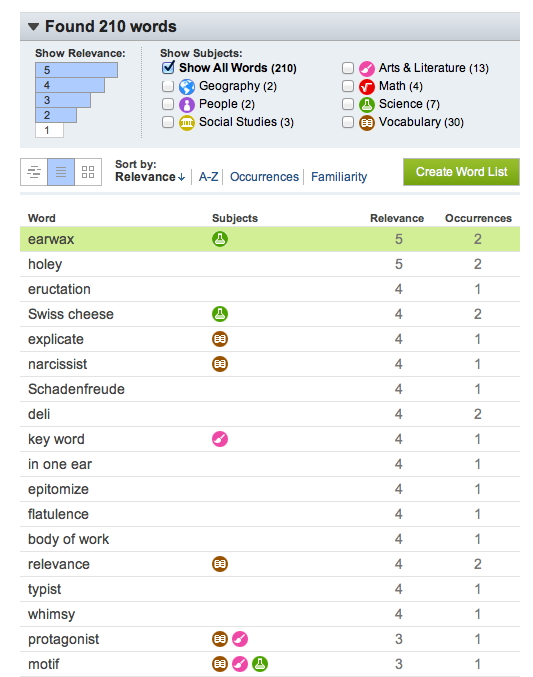
Although I am only a typist, it occurred to me that perhaps I have unwittingly or possibly half-wittingly employed leitwortstil on this blog. This led me to VocabGrabber, a website that allows you to enter a text and sort the words by relevance, occurrence, and familiarity. In addition, words are marked in seven categories: geography, people, social studies, arts and literature, math, science, and the puzzling category called vocabulary. You can imagine how helpful a website like this if you need to waste several hours of your life.

In a desperate search for my leitwortstil, I began copying and pasting my posts into VocabGrabber and made three important discoveries. First, the two words I repeatedly repeat are “are” and “have.” My literary style of typing brings truth and light into the world by explicating and complicating the two basic human needs: existence and possessions. As Descartes might say if he were still alive and we were both yearstricken: we are, therefore we have.


The second important discovery came when I entered the text for my blog about joining the pantheon of the blog gods. Overcome with whimsy, I clicked on the relevance button, which VocabGrabber declares are the words “most significant for the average reader.”  In that post. the most relevant word to you, dear reader, is earwax, a word lodged in your mind and ears in a strikingly relevant way. And right after earwax, I discover that eructation is important to you, followed by narcissist, key word, epitomize, and flatulence.


For research purposes and because I have wasted so much time at VocabGrabber what is another ten minutes, I typed in all of the above paragraphs. You still find earwax the most relevant, followed by holey, eructation, Swiss cheese, explicate, and narcissist. You people surprise me. I had no idea these things meant so much to you. I did notice that you are not having as much trouble with your flatulence today. I’m happy to hear that, or not hear that if you know what I mean, and I’m sure the people around you are too.


My third discovery daunted me. VocabGrabber reveals more about word usage than leitwortstil, so I must continue my quest. And it reveals more about you than you may have wanted me to know. I will try to use this knowledge wisely. Your secrets are safe with me.

Have you thanked your word surgeon today?

Standard

I just found out from my imagination that today is national Thank a Word Surgeon Day! So I am very excited because as you know, or will know after you finish this sentence, I am a word surgeon. So, thank you, me.

Without word surgeons, no lips would whisper melodies out of flutes, no hand would wield the wild épée, slicing and dicing the villains of the world, and machines would never have the chance to learn to hum. Every flute deserves a kiss from lips, every épée needs to slash out now and then, and all machines deserve to experience the electric thrill of on-ness.


Ever vigilant word surgeons roam the earth searching for nouns, rummaging through old dictionaries, discovering new inventions, reading people’s e-mails, and writing blogs. They are ordinary people who look just like you and me, although I’m pretty sure your mom could tell the difference.


Most of them are kind-hearted people, working late into the night, affixing words that will benefit humankind. One of their favorite suffixes is “-ist.” On discovering the flute, one of them delicately removed the “e,” added the “-ist,” and voilà, the flutist was born. Flutist should not  be confused with flautist, which came later, and was formed by an amateur flaunting his knowledge of Italian. This is where we get the word “flauntist,” which means one who flaunts. Still another professional took the time to add “-ist” to an épée  and Errol Flynn was born, one of the greatest pretend épéeists in the world, who swashbuckled his way into the hearts of millions of moviegoers in the 1930s and 1940s. And finally, I must mention the word surgeon who set the gears of the Industrial Revolution in motion, creating millions of jobs, by having the foresight to drop the “e” and attach “-ist” to a machine.


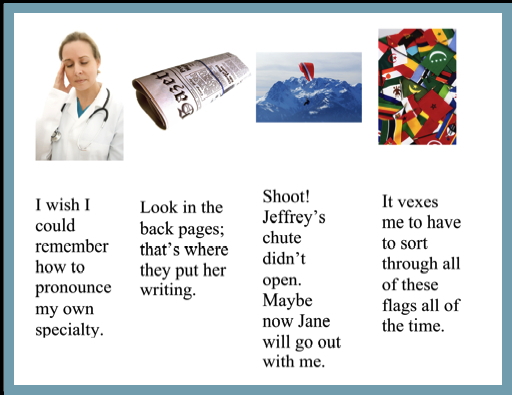
Word surgeons have taken simple nouns and given the world pianists, chemists, and typists. You should be thankful they are not afraid of big words or words that are hard to pronounce. We have them to thank for the otorhinolaryngologist, the feuilletonist, the chutist, and the vexillologist.

However, word surgery is not all fun and games, friends. Bad bananas happen. Sexists, agists, and racists came from somewhere. Don’t blame word surgeons. They don’t take responsibility for bad words, only good words. And if you judge them, they will make bad words about you. It’s what they do: make words.


Because of those bad bananas, “-ist” has been called The Intolerant Suffix by at least one word surgeon I know intimately. And although I fully recognize the dangers, I am going to illustrate how this works. The intolerant part, not the intimate part.  Please understand that the following words are for illustration only and should not be seen as an endorsement or encouragement toward intolerance.

  • Plaid makes you cry – you are a plaidist.
  • Being asked to play another game of Monopoly makes you gag – you are a monopolist.
  • Big hair makes you scream – you are a bouffantist.
  • People who act like donkeys or fools sicken you – you are an assist.
  • Hearing a woman called a “Ho” in a song makes you break things – you are a hoist.
  • Wearing strings instead of panties makes you uncomfortable – you are a thongist.
  • Hearing the f-word all day long makes you want to hit someone – you are a fist.
  • Irons and ironing boards are not allowed in your home – you are an ironist.

Some of you may be tempted to try this at home. I urge you to use caution. Remember, if anything bad comes of it, don’t blame me. However, if anything good comes from it, you can thank me because today is Thank a Word Surgeon Day!

Thanks, nodgecomb

Standard


That great Word Census, known as the OED, keeps records on the words populating the minds and mouths of English speakers. Some words, like “double,” have been around since 1290 doing twice the work of most verbs. Others die young.  For instance, “nodgecomb,” called both a simpleton and a fool, grew up in England in the 1500s and then suddenly died. We have no record of why he died, so there’s no way to dispute my claim that he was killed when he was caught poaching. At that time, most of the forests in England belonged to the royals, and under the sumptuary laws of Elizabethan England, unless you were granted a royal license, you could not hunt. Punishment for poaching included hanging, castration, and blinding. Few people know this (and I didn’t even know myself until I thought of it), but since the price for poached deer was so high, the English peasants began raising chickens and poaching their own eggs instead. If you had poached eggs this morning, you have nodgecomb to thank.


At this point, I probably should insert a line of little asterisks, but I’m not sure, so please just go the next paragraph. It also has something to do with the OED.

In the December census, the OED listed “posilutely” as a newcomer. Although it was born in 1988 in a dog’s mouth (Dodger in the movie “Oliver and Co.), it’s now safe to put in your mouth; it has the OED seal of approval, so you won’t get germs. I don’t know if its counterpart, “absotively,” is in the OED because I don’t have a bookshelf big enough to hold that many volumes or a bank account big enough to buy it.


They have an online subscription that I am considering. I hope by the time I sign up “nodgecomb” has been revived. We have a lot in common; not the poaching part, the simpleton part.


Lovesome words and politics

Standard

Why, why, why didn't I download that dictionary app when I had the chance?

Defenestration is my new best word friend forever (BWFF) or until a smarter looking one comes along.


First, it has five syllables, which makes it what is known in etymological circles as a “big” word. Big words are not only a sign of intelligence but can also be used to flummox your friends. Because no one wants to admit that they don’t know the meaning of a big word. Like, really.


Here’s how flummoxing works:


You: I’m so tired!


Your friend: Why? What did you do on the weekend?


You: I was reading a book without a proper ending and I got so riled up, I defenestrated it. It felt so good that I went through the house and defenestrated things for hours. How about you? Did you do any defenestrating over the weekend?


Your friend: Uh…well…yeah, actually…oh, I think I have a message on my phone. Excuse me for a minute.


At this point, your friend will pretend to be checking his or her phone for messages but actually will be looking the word up. But only if the now former friend remembered to download the dictionary app. (Did I mention that flummox is French for “confuse and lose friends”?)


Flummoxing aside, I love the word for the story behind it. The Thirty Years’ War in Europe started in 1618 when some Bohemian nobles threw two government officials and their secretary out of a window to protest the violation of their religious rights. Throwing people out of windows was apparently a common pastime of Bohemians of that day, but up until then, no one knew quite the right word to express it.  The three human projectiles that set off the war landed on a pile of rubbish, and so escaped, bruised and smelling of rotten cabbage, but alive. Thankfully, video cameras had not been invented back then; otherwise, defenestration would become a meme like planking, and people who don’t know big words would be defenestrating all over the place.

Elections: windows of opportunity to practice defenestration

This pane-ful act gave birth to the word we now know as defenestration, which means “to throw out of a window.”  It combines the prefix de-, which gives the meaning of something removed or put away, with the Latin word for window, fenestra.


You see how lovesome the word is. Its story reminds me that there are a number of government officials that I would like to defenestrate, particularly those who have failed to compromise and do what’s right for the country, instead of licking the boots of lobbyists and big money contributors. Election time is our window of opportunity, people. Rise up and defenestrate.


A Word is Born

Standard

I love the little book The Elements of Style for two reasons. First, it offers great writing advice, that I have often been tempted to put into practice. But more importantly, the author’s name is Strunk. If I had not been blinded by the kindness, faithfulness, funniness, and handsomeness of my husband, I would have married someone with a more interesting last name, something like Strunk.  Teacher Strunk has such a nice sound, although if you say it very fast several times, it begins to sound like teacher’s drunk.

Ancestry.com says the name comes from Germany, the place that also gave us Colonel Klink. Another name I wish was mine.  The Germans are also responsible for the pattern of vowel change in some of our irregular verbs like drink, drank, drunk and shrink, shrank, shrunk. But whatever happened  to the trio of  think, thank, thunk? Down in Texas we thank about things like that, and when we notice that we don’t think anymore, we say, who woulda thunk it?

But back to that tantalizing name, Strunk. Why has no one coupled the content of the book with the author’s name and coined a verb to describe the act of revising and perfecting a composition?

(strink – /strɪŋk/ verb, strank (past tense), strunk (past participle) — to apply the principles of The Elements of Style to a manuscript or composition)

Yearstricken: (passing the essay back to the student) You need to strink this.

Student: But teacher, I strank it last night.

Yearstricken: (growing more alliterative by the moment) Strink harder! Only the student who has strunk sufficiently succeeds and scores an A.

Thunk! The sound of me coining a word.