How much is that doggie in the window?

Standard

One of the chief delights of blogging is discovering writers, cooks, painters, photographers, teachers, and poets who delight and instruct you. One blogger who does just that is RAB at You Knew What I Meant. A multi-talented woman who also teaches college-level writing and literature, RAB draws from her collection of bloopers written by her students and comments about them on her blog. She ranges from serious and thoughtful to wry and funny. I learn something from her every day. If you go there, you will too, and you will not be disappointed.


Today I asked her to write something for my blog. Enjoy!

RAB and her younger sister: a little older but probably no wiser.

That parents would think their kids are special comes as no surprise: it seems to be part of the job description. I was blessed with parents who encouraged and supported their children while still trying to help them keep their perspective on their own achievements. But that didn’t keep my sisters and me from deciding we were, more or less, Infant Phenomenons. My parents’ smiles at manifestations of that were, I’m sure, part pride and part enormous amusement. And sometimes they also had to draw on what seem in retrospect to have been infinite stores of patience.


Here’s my most vivid recollection of one of those instances.


My sister and I were quite taken with the television show Arthur Godfrey’s Talent Scouts. Reading about it now, I find it was the #2 television hit show during the 1950s. People would come on the show and perform; at the end of the program the audience would applaud, and the applause-o-meter would indicate the winning act. Kind of like American Idol, but without the hoopla or the nastiness.


I imagine that, in what has become the pattern of televised contests, at some point in every show somebody explained the procedures and rules; but I’m not sure that anybody ever explained where the acts had come from. Helen and I reasoned that since the show was called Arthur Godfrey’s Talent Scouts, the acts must have been found by a band of talent scouts, whatever that might mean, who brought their discoveries back to Arthur Godfrey so he could put them on his show. And Helen and I formed the ambition not only to be found and brought back, but also to win the prize.


When I was six and Helen was three (and my other sister was yet to be born), my parents decided to make the first of what would be three family car trips to Florida. That was before Route I-95: they planned to drive from New Jersey to Florida on Route 1, stopping for meals etc. but otherwise driving straight through the night, alternating the driving between them. My father stowed the family luggage in the back seat foot wells and then laid a crib mattress down, covering luggage and back seat. This made a luxuriously spacious bed-cum-recreational space for Helen and me, with room for coloring books, a few stuffed toys, Weenie the sacred blanket (shreds), and bedding. There is no more magically comforting experience, I think, for a child than lying drowsily in the back seat of the family car, looking up at the stars through the back window, and hearing Mommy and Daddy conversing softly and seemingly far away in the front seat over the hiss of the tires on the ribbon of paved road. The drive down had that kind of magical peace, even when we were awake and trying to be the first to see a car with a Delaware…and then Maryland…and then Virginia…license plate.


Once in Florida, we cavorted on beaches and visited relatives and met some nice people from Michigan who were staying in the motel unit next to ours. And at some point, for some reason, we developed the plan for being discovered by Arthur Godfrey. This plan must have made the return trip from Florida to New Jersey sheer hell for our parents.


How do Talent Scouts operate, after all? Well, I knew what Girl Scouts and Boy Scouts did, having read about them and aspiring to join GSA (for the uniform): they hiked around, especially in the woods. They looked at things. They collected things. I had also read about Indian Scouts, who traveled around looking for bent twigs and other important things along the trail. So Helen and I figured that Talent Scouts probably drove the roads of America looking for talent. We were too young to have much of an idea of what went on in night clubs and the like, so it didn’t occur to us that the Talent Scouts might be traveling to look at actual ACTS. Our notion was, they kept their eyes and ears open for Talent wherever it might be—someone singing in church, somebody doing cartwheels in her yard, somebody tap-dancing with friends at school or maybe on the sidewalk. What more likely place for the Talent Scouts to be driving, we thought, than Route ONE?


Our plan was to get discovered on the way home to New Jersey. And so we insisted on riding with the windows open as we sang our best number, “How Much Is That Doggie in the Window?” It was a pretty big hit at the time, and we fancied our rendition of it quite a bit, especially the “Arf! Arf!” part. No one in a passing car would be able to see Helen’s affecting gestures of desire as we peered through an imaginary pet-shop window, but our voices alone would surely cause any Scouts worth Arthur Godfrey’s imprimatur to shout over to Daddy and ask him to pull over and let them meet the Amazingly Talented Girls. Because it was impossible to know exactly where or when the Scouts would be driving by, we of course had to sing the song over and over. And over.


My parents made the drive from New Jersey to the Florida border in exactly twenty-four hours. I’m sure the drive home was faster.


I will love them forever for never once telling us the truth about Arthur Godfrey’s Talent Scouts, or asking us to call a halt to our naïve and lusty audition.


Grown-up tattling

Standard

My husband grew up in the Midwest, Land of a Thousand Kindnesses, and came from a family who speak kindly of one another. The first time I met his parents and five siblings, I was shocked. They reminded me of The Waltons, the popular TV family of the 1970s. At family gatherings when my husband’s family told stories about one another, everyone minded everyone else’s feelings, so at the end of their stories, you expected everyone to stand up for a group hug and one more family photo.


My family grew up in Texas, sometimes, but we moved now and then just to see if growing up somewhere else would make us any different. It didn’t. We were the people from Peyton Place no matter where we lived. The soap opera known as Peyton Place first aired in the mid-1960s, shocking some and entertaining others with its stories of divorce, infidelity, imprisonment, and revenge. Just like my family, except that our show ran every day, while Peyton Place only ran two or three episodes a week. At our family gatherings when we told stories, no one worried about anyone’s feelings, we told the most embarrassing stories about each other that we could remember and ended up rolling on the floor hooting and hollering, and sometimes snorting through our noses because none of us could believe the dumb things the others were capable of.


In my family teasing has always been a sign of affection, and our favorite way of teasing is to tell on one another. When you are a child, telling on someone means you are tattling: trying to win the favor of whoever is in charge, either to look good or avoid punishment. Our grown-up tattling is after the fact and has no other purpose than to point out the obvious: we be dumb now and again. And the more we tell the stories on one another, the kindlier we feel toward one another.


So when my husband met my family, he was shocked. It didn’t dissuade him from marrying me, however, because I made sure we were already married before he met them. (Note to reader: Contrary to what my family says, I’m not as dumb as I look and sound.)


If, in the telling of a story about a sibling, we see signs of embarrassment or hear attempts to explain or justify, that story will become a signature story, one we will tell again and again, every chance we get. Because that’s what love does.


My mother never took part in any of this teasing. Of the four siblings I grew up with, only two of us shared the same father. The other two had their own fathers, yet we all share the same sense of humor. Maybe mother was merely the carrier of the slightly off-kilter humor that manifested itself in her children.


Of course everything I have written up until now is just an excuse to tell on the two siblings that I know are still alive. One of these posts I will explain more about my known and unknown siblings. But until then, here’s me showing some love to my brother and sister.

My brother in a littler time

Brother story

Until my brother came along ten years after me, I was the baby of the family. Mother indulged him not only because he was the youngest, but also because he was a boy, something I had been expected to be, but failed. When he was five years old, we lived in military housing in Fort Wainwright, Alaska. One day when he was shopping with mother at the commissary, he asked for some strawberry preserves. Mother tried to talk him out of it and told him he wouldn’t like it because it had chunks of fruit inside, but he insisted. The next day she put the preserves on his peanut butter sandwich, and after one bite, he knew mother was right: he didn’t like preserves. Mother insisted that he eat the sandwich, and then left him alone in the kitchen. He pulled the two pieces of bread apart, thinking he might be able to salvage the peanut butter side. It, too, was ruined. I’m sure that we had a garbage can in the kitchen, and I know that my brother had seen people throw things in the garbage, so it wasn’t as if he didn’t know how to dispose of the bread. He must have feared that mother would see the uneaten sandwich languishing in the trash, so he did what any reasonable person would do. He picked up the rug in front of the kitchen sink, placed one slice of the bread on the floor, and carefully covered it with the rug so that it was hidden. Then he took the other piece, opened the basement door, and flung it down the stairs. After all, who would think to look there? He doesn’t remember if mother found the first slice before or after she stepped on the rug; he can’t remember any consequences at all. Since he was the youngest, there probably weren’t consequences.

One of the few days the world left my sister's hair alone

Sister story

As a young girl and teenager, my sister suffered from Tourette’s of the Hair. Most nights she lathered her hair in Dippity-do, wrapped the strands in pink pokey, plastic rollers; large, bristly, netted curlers; or soft, spongy snap-ons in the belief that she could make her hair bend to her will. More often than not, it didn’t. Some nights the hair wriggled out of the curlers; other nights the curlers twisted the wrong way. When she commanded it to flip up, it flipped down. Or if she ordered it to swoosh that way, it drooped the other way. This made bad words come of her mouth. She developed two theories based on her hair. First, she believed the world had an interest in how her hair turned out each morning. Nice hair displeased the world; it was completely and utterly against her quest to be the best tressed at school, and, in fact, wanted her to go to school with failed hair. Second, she convinced herself that the answer to obedient hair resided in the bathroom counter. She hypothesized that by striking the counter hard enough and often enough with a comb, brush, or curling iron, her hair would suddenly flip or swoosh the right way. It took a number of years and a pile of broken hair appliances before she accepted the fact that the counter was merely an innocent bystander. She told me later with some regret that she passed this problem onto her daughter. She is still working on the problem of the world being against her.

In the interest of fairness, I should include a story about myself. Unfortunately, I have run out of space. Really. If I write any more I will bump into those little icons under this sentence.

Love in the time of garlic

Standard

The picture of Saint Valentine, patron of lovers, depicts him with birds at his feet and roses at his side. Geoffrey Chaucer is responsible for the birds. People in the Middle Ages believed that birds chose their mates in the middle of February. In his Parliament of Foules, Chaucer wrote: “For this was on seynt Valentynes day/ Whan every foul cometh ther to chese his make” (309/310). The spelling looks remarkably like that found in modern text messages and e-mails. To comfort myself at night, I tell myself that young people are not bad spellers, they are merely returning to Middle English, the language of Chaucer.


We can hold the Greeks and Romans responsible for the roses at Saint Valentine’s side because like Chaucer they are not here to defend themselves. Many of their stories about the god of love, Eros to the Greeks, Cupid to the Romans, included roses.


If I could embellish the saint’s picture, I would have him hold a box of dark chocolates in his right hand and next to the roses plant some stinking roses, an affectionate name for garlic. For me, love isn’t love if it doesn’t smell of garlic.


Part of the attraction between my husband and me is the love of garlic. For our anniversary a few years ago, we bought one another garlic presses. He was traveling and had to spend several months living on his own. How could I send him out into the world without a garlic press? The one we had at the time was old, so we went to a kitchen specialty store and shopped together. He looked over the presses and chose a conventional one that crushes the garlic, while I dithered over the deluxe model that could crush or slice, even at the same time! In spite of the high cost, he bought it for me. If that isn’t love, I don’t know what is.

No matter how you slice it, this garlic press proves my husband has a crush on me.

Over the years we have met people who do not or cannot eat garlic. We understand those who cannot eat garlic, but not those who choose not to. We will still love you if you don’t eat garlic, but we will probably talk about you behind your back.


“Gert is coming over for dinner, honey, so we can’t use any garlic.”


Look of consternation. “Does she have a doctor’s note?”


Look of surprise. “You know I forgot to ask. She looks so honest, and she said it upsets her stomach.”


Later that day on the phone. “Hi, Gert. About your allergy to garlic. My husband and I were wondering, do you have any kind of documentation? It’s not necessary, of course, but if you have some, we would really like you to bring it with you tonight when you come over for dinner.”


Tonight, in honor of St. Valentine and his name, which comes from the Latin valens meaning strong, powerful, and healthy, I plan to make something strong, powerful, and healthy: Death by Garlic pasta. You can find a number of recipes online, but go here to find a simple one that uses 10 cloves of garlic. If that sounds too wimpy, or you have a fear of vampires, or you are feeling particularly romantic, you can double the amount of garlic and fall in love twice as hard. Otherwise, just cut a clove of garlic and rub it behind your ears and on your pulse points. If your husband is anything like mine, he will do anything you say.


If you are still wondering what to buy your loved one for this special day, remember that while flowers and chocolates are always welcome, nothing says Valentine’s Day like the fine bouquet of the stinking rose.


Leitwortstil

Standard

Let’s be honest, leitwortstil looks like something you order at the deli. “I’d like a pound of the best wurst you have, two pounds of un-holey Swiss cheese, and half a pound of leitwortstil.”


Now, for the sake of fairness, since we have been honest, let’s be dishonest. Or rather, let’s be imaginative and fictional and say you make this order at a word deli. Afterwards, you go home and write a story in which you make the protagonist eat “best wurst” and “un-holey Swiss cheese” meal after meal because that’s what leitwortstil does to you.


When Germans try to say “leading-word style” in English, it comes out sounding like leitwortstil, so we must learn to deal with that. This is a good reminder to English speakers to make sure to be the first ones to say new words; otherwise, we will be stuck with words that are hard to pronounce, like Schadenfreude and Fahrvergnügen. Leitwortstil, which should technically be capitalized since it is a German Noun, is the repetition of certain words or phrases in a story or body of work that the writer uses to develop a motif or theme. In layman’s terms, think of it as the “Are we there yet?” refrain that a child repeats over and over on a cross-country car trip, which helps establish the theme of your family vacation and ultimately your life: madness.


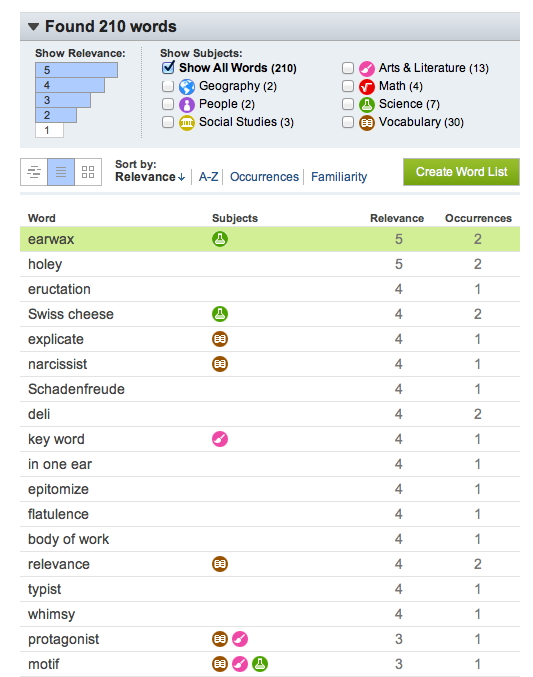
Although I am only a typist, it occurred to me that perhaps I have unwittingly or possibly half-wittingly employed leitwortstil on this blog. This led me to VocabGrabber, a website that allows you to enter a text and sort the words by relevance, occurrence, and familiarity. In addition, words are marked in seven categories: geography, people, social studies, arts and literature, math, science, and the puzzling category called vocabulary. You can imagine how helpful a website like this if you need to waste several hours of your life.

In a desperate search for my leitwortstil, I began copying and pasting my posts into VocabGrabber and made three important discoveries. First, the two words I repeatedly repeat are “are” and “have.” My literary style of typing brings truth and light into the world by explicating and complicating the two basic human needs: existence and possessions. As Descartes might say if he were still alive and we were both yearstricken: we are, therefore we have.


The second important discovery came when I entered the text for my blog about joining the pantheon of the blog gods. Overcome with whimsy, I clicked on the relevance button, which VocabGrabber declares are the words “most significant for the average reader.”  In that post. the most relevant word to you, dear reader, is earwax, a word lodged in your mind and ears in a strikingly relevant way. And right after earwax, I discover that eructation is important to you, followed by narcissist, key word, epitomize, and flatulence.


For research purposes and because I have wasted so much time at VocabGrabber what is another ten minutes, I typed in all of the above paragraphs. You still find earwax the most relevant, followed by holey, eructation, Swiss cheese, explicate, and narcissist. You people surprise me. I had no idea these things meant so much to you. I did notice that you are not having as much trouble with your flatulence today. I’m happy to hear that, or not hear that if you know what I mean, and I’m sure the people around you are too.


My third discovery daunted me. VocabGrabber reveals more about word usage than leitwortstil, so I must continue my quest. And it reveals more about you than you may have wanted me to know. I will try to use this knowledge wisely. Your secrets are safe with me.

Listening to your eyes

Standard

Sight seems simple enough. First, you open your eyes. If the room is dark, you go back to sleep. If not, the lenses in your eyes focus. If your eyes find this difficult to do, your nose offers to hold your external lenses because it, too, would like to get a better look at what is right in front of it. Photons of light, like tourists hurrying off the bus, rush into your eyes to see your retina. They crowd around the retina while the brain takes their pictures, and then they rush out, so the next crowd can come in. Some of the same ones visit every single day. Apparently they have nothing better to do, or perhaps the retina is worth seeing again and again.


The brain collects these photos from morning till night, ignoring the most familiar, studying the unfamiliar, and sorting them into piles of those it likes and those it doesn’t. But what is the point of taking pictures if you don’t have someone to share them with? So, the brain shares them with the heart and that complicates sight. Hearts may be born with 20/20 vision, but over time they can change. Life can scar the lens of the heart and pressure can change its ability to focus. An astigmatic heart can’t see clearly, and looking through the lens of expectations only makes it half-blind. Even with the corrective lenses of a friend, lover, or family member, some things remain distorted, blurry, or impossible to see.


If the heart insists loudly and persistently enough that its way of seeing things is true, the brain can start believing the heart instead of the eyes. And the heart is often right. The eyes need light to see; the heart sees in both the light and the dark and can feel truth even when she can’t see it.

But sometimes the heart isn’t right. You come to a crossroads and see a sign telling you where you are. The heart reads the unfamiliar script, not even sure how to pronounce it. Lost again, she says. One more sign of failure. Everyone, except me, knows where to belong. I will never find my way home now. The eyes, however, see the bright, bold letters, the flourishes around the words put there by some sign painter writing his heart in simple words for the weary traveller who would surely walk this way and need some direction. You are here. Just follow the sign. A place of rest lies up ahead. This road might be the one that leads you home.


This time the eyes are right. The heart must trust and follow.

I dream of flying

Standard

For as long as I have remembered, I have dreamt of flying. I stand under a blue sky with my arms lifted and then gently push off from the earth and fly, almost float, above my world.  Hope follows me out of these dreams, and I feel as if I share a secret with the sky.


When I was five or six, my father went on a trip and came home with a bracelet and necklace for me. I still have the set. Patterned after the silver and turquoise jewelry common among Native American tribes of the West, it is imitation jewelry, made for children. The necklace holds a rounded horseshoe-shaped piece in the middle, and my father told me that if I held that piece and made a wish, any wish, it would come true.


When you are a child, your nighttime dreams seem as real as your daytime life. I never thought that I was just dreaming about flying; I believed I was flying at night. In the morning, I landed back in this other world, held firmly in the arms of the jealous earth.

The day after I received the jewelry set from my father, I stood on the red brick planter in front of our porch, wearing the bracelet and necklace. One hand grasped the turquoise piece in the middle of the necklace, and the other held my nighttime dream, wrapped up in a daytime wish. I named my wish and saw myself soaring near the elm trees in the yard. Then I jumped.


The earth would not let go of me, and I landed on my feet, one hand still grasping the necklace, the other one empty. I watched my hope take wing and leave me, the sky indifferent to my longing. Children have their own sorrows and know the loss of dreams, sometimes before they have the words to tell you.


For many years, I kept a journal of my nighttime dreams, but for the last five years, my mind has chosen to forget. The other night I stood in a field and the sky called for me, like an old friend inviting me back. Featherless, I flew into that place of my childhood joy, the place of belonging. When I awoke, I could almost hear birds singing in the empty winter trees, a song familiar and forgotten, with a melody of hope.

The key to increasing your readership

Standard

Yesterday morning was a dark and stormy night that found me in a twist of strange fate. On the way to untwisting it, I discovered the key to increased readership! Yes, it’s true; I have another secret to reveal to the world. And once again, I am providing it free of charge. Second because I care about you. First because I tried selling you Dog and a Half word kits and you ignored me. How sad is that? Sad enough that I couldn’t even put it first.


My morning routine seldom varies: up at 4:30 a.m. for first dose of medicine (p.o., Latin for “per os” meaning “by mouth”); ingest ½ cup of granola, followed by reading/internet time; second dose of medicine, as needed; and finally, morning typing time.


The dark and stormy night started with the typing. The more I pushed on the keys, the more I felt like I was pushing on bruises in my heart. I tried typing softly, but it kept hurting. Certain keys produced  tear drops, which as you know can mess up your computer. So, I stopped and felt better and saved my laptop. It’s what I do.


Are you a Freud of psychoanalysis? (Image courtesy of Wikipedia.)

During my time at work, my fate remained hideous kinky, which, if you know anything about the movie of that title, has Freudian connections, much like my life. When I left school late yesterday afternoon, I barely got home before night fell. Thankfully I got there first, and watched through the picture window as the darkness crashed down.  Safely ensconced in my recliner, I opened my laptop, only to be gobsmacked. Yes, smacked right on the gob!


Fast backward. A few weeks ago, my blog was in an accident. WordPress reported it on their front page, so a lot of people came over to see it. Most, of course, took one look, felt disappointed, and left. Over the next few days, some came back, but eventually the onlookers tapered off. The graph below tells the sad, sordid story.


Fast forward. Things returned to normal, I produced wreck after wreck, but not very gawk-worthy.


Pause. Sorry, this is a gratuitous use of language. Somehow I got stuck in this tape recorder image.


Play. We left off at the gobsmacking. When I checked my stats last night, I had almost as many views as the previous day. The only difference was that I hadn’t posted anything. This morning I see that the day I didn’t post, I got more views than in the previous five days when I did post. You need a magnifying glass to see the difference, but trust me, the orange arrow non-posting day has more views.


Can you imagine my excitement? I have discovered the key to increased readership: Do Not Post! It seems counterintuitive, but all new discoveries appear that way at first.


Oddly, I must post today in order to share this information with you. However, because I am posting it, you probably will not read it. I am like Hamlet, or since I am female, Hamlette, pondering whether to post, or not to post.


I hope this helps you. I have more to say, but it will have to wait for a day I don’t post. I certainly hope you come back then.


Wealth by toothpaste

Standard

Would you like to become fabulously wealthy just by using toothpaste correctly? If you’re like most people, you answered yes. Now, would you like to know the secret behind wealth by toothpaste? You know you would. Finally, would you like to get the secret at no extra cost to you? Friends, your answer to this last question disappoints me. You want me to reveal my secret for nothing. How do you expect me to become fabulously wealthy if I give this secret away?


But don’t worry about me, friends. I’ve grown use to the taste of dry oatmeal three meals a day. So today, you are the lucky beneficiary of my largesse. Hold onto your dentures because I am going reveal the fluoride way to lots of money. With pictures!


First, I can’t emphasize enough the need to squeeze that tube of toothpaste. Never squeeze in the middle of the tube. From day one, you must apply pressure from the bottom of the tube, gripping each side with thumbs and forefingers, pushing upward. Done properly, your tube will look like the one below.

Frontal view of so-called empty tube of toothpaste

Some people are easily fooled into thinking it's empty.

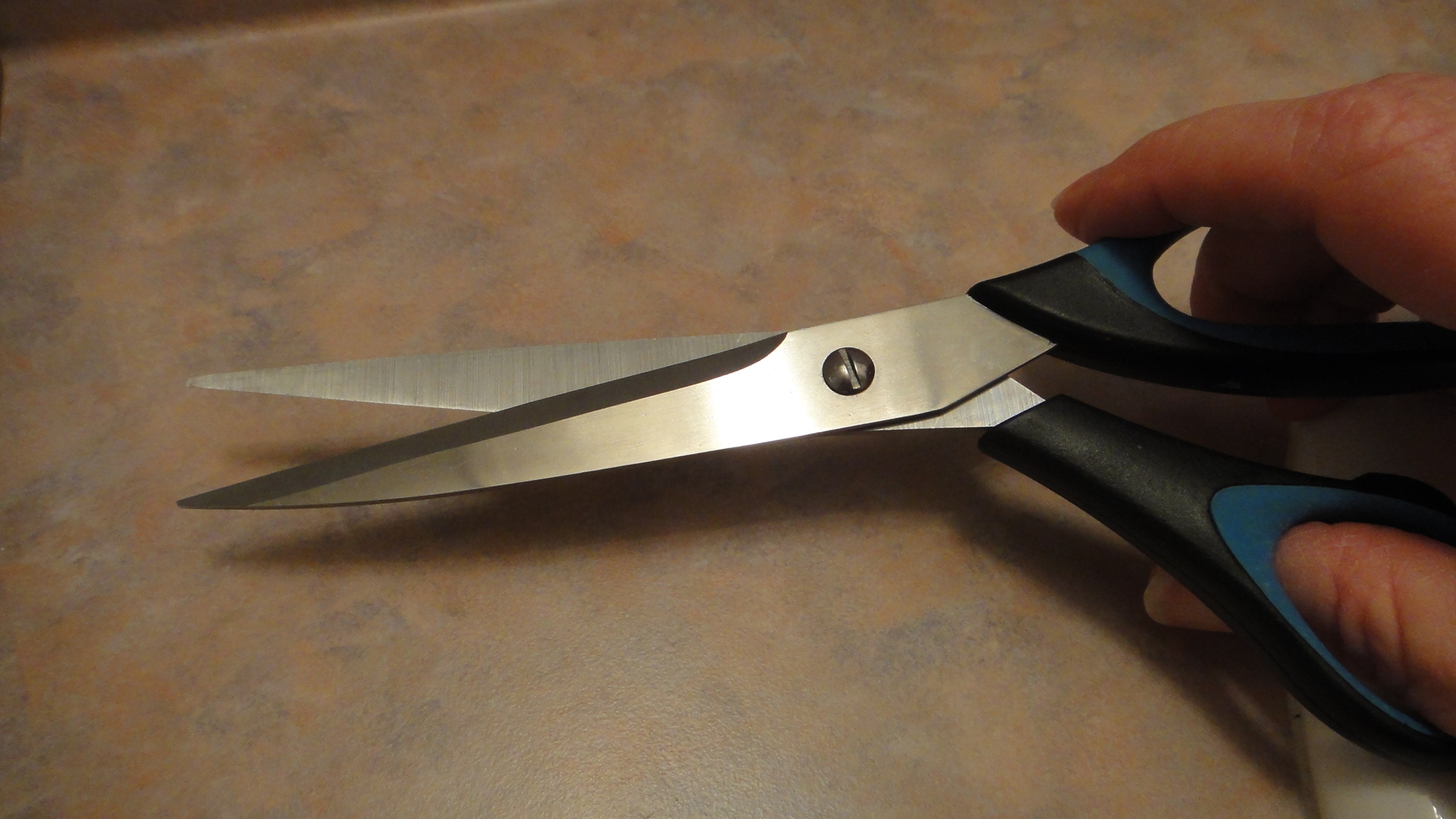
Sadly, many people see a tube like that and think all of the toothpaste is gone! I know better, and soon you will, too. How, you ask. Well, the answer is probably lurking in your junk drawer: a simple pair of scissors. Why don’t more people think of this? I believe it’s because “scissors” is a defective noun (Latin, plurale tantum), one of those words that has only a plural form. It’s one thing to find a scissor in your junk drawer; it’s another thing altogether to find a pair.

Hand-held defective noun.

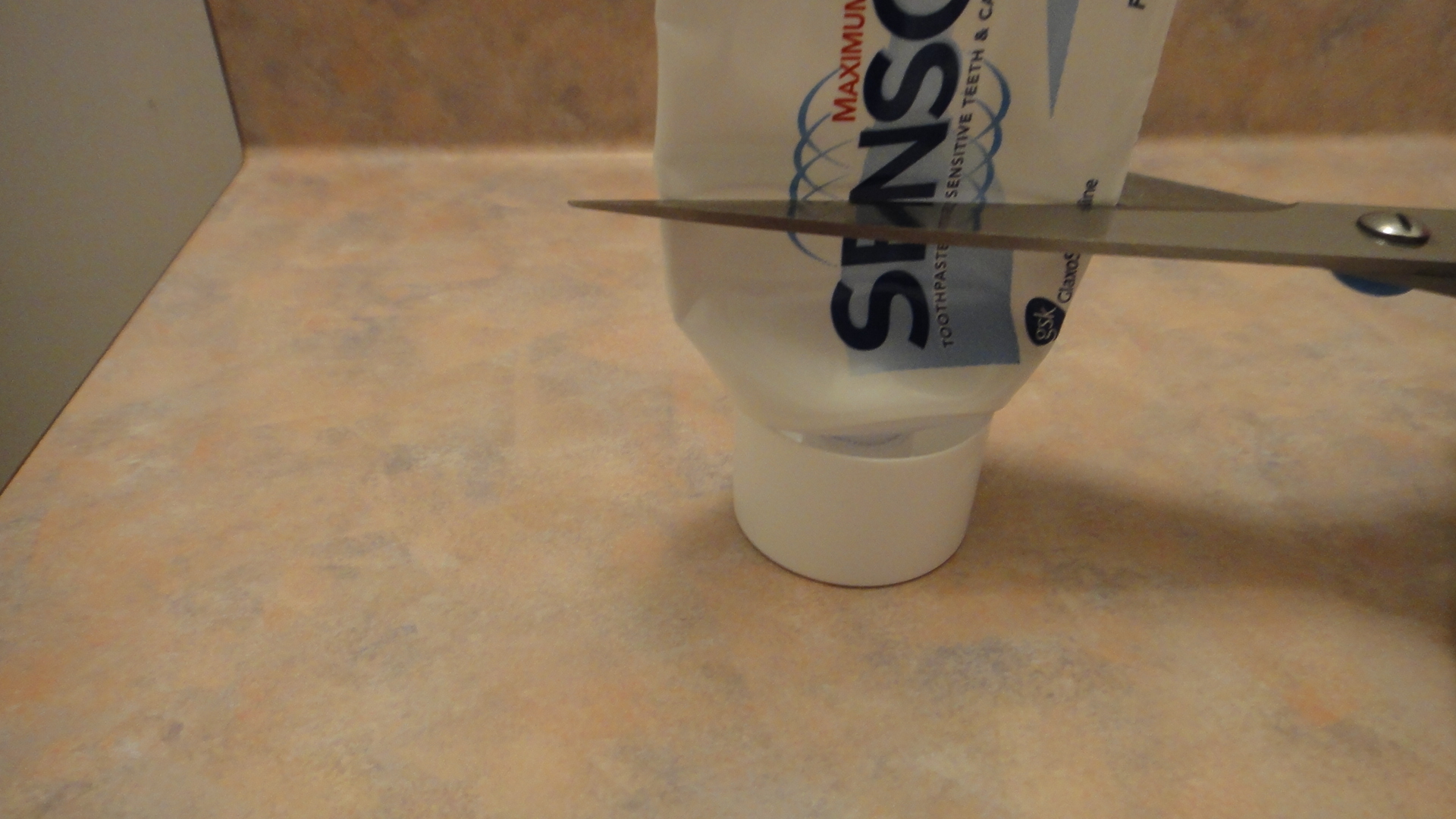
Use your hand to operate the scissors, then cut quickly and sharply, leaving 1.6” at the top. Use a ruler if necessary.

Both toothpaste tubes and defective nouns require squeezing. Weird, isn't it?

At this point, you should look inside and marvel at the amount of toothpaste that you almost threw away! Some people see little dollar signs the first time they look inside a cut tube. If this happens to you, don’t be alarmed, just don’t tell anyone else.

Yes, that much was inside that tube!

Some people say they see dollar signs in this. I don't,but some do.

To prevent the exposed toothpaste from drying out, you need to place the tube in a container.

It's almost like a piggy bank.

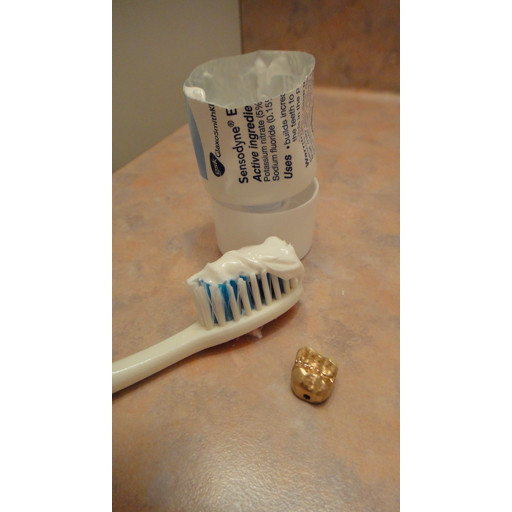
If you are not squeamish and don’t share your toothpaste with anyone else, you can just dip your dry toothbrush in the opening to use up the toothpaste. If you share the tube, be sure not to tell the other person you are doing this. Tell them you are using the next method.

Dip into tube for toothpaste. Don' t forget to brush any gold crowns you have lying around that were once on your mother's charm bracelet.

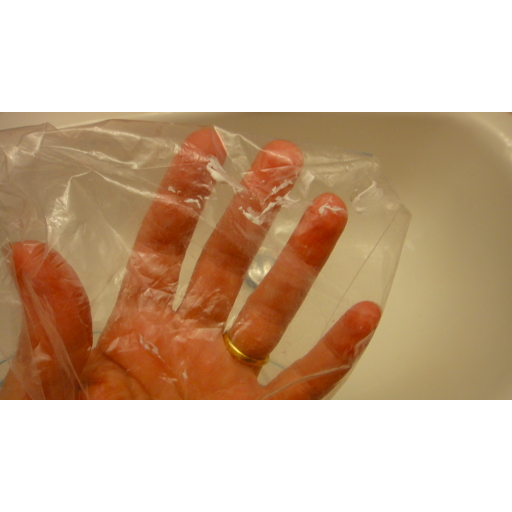
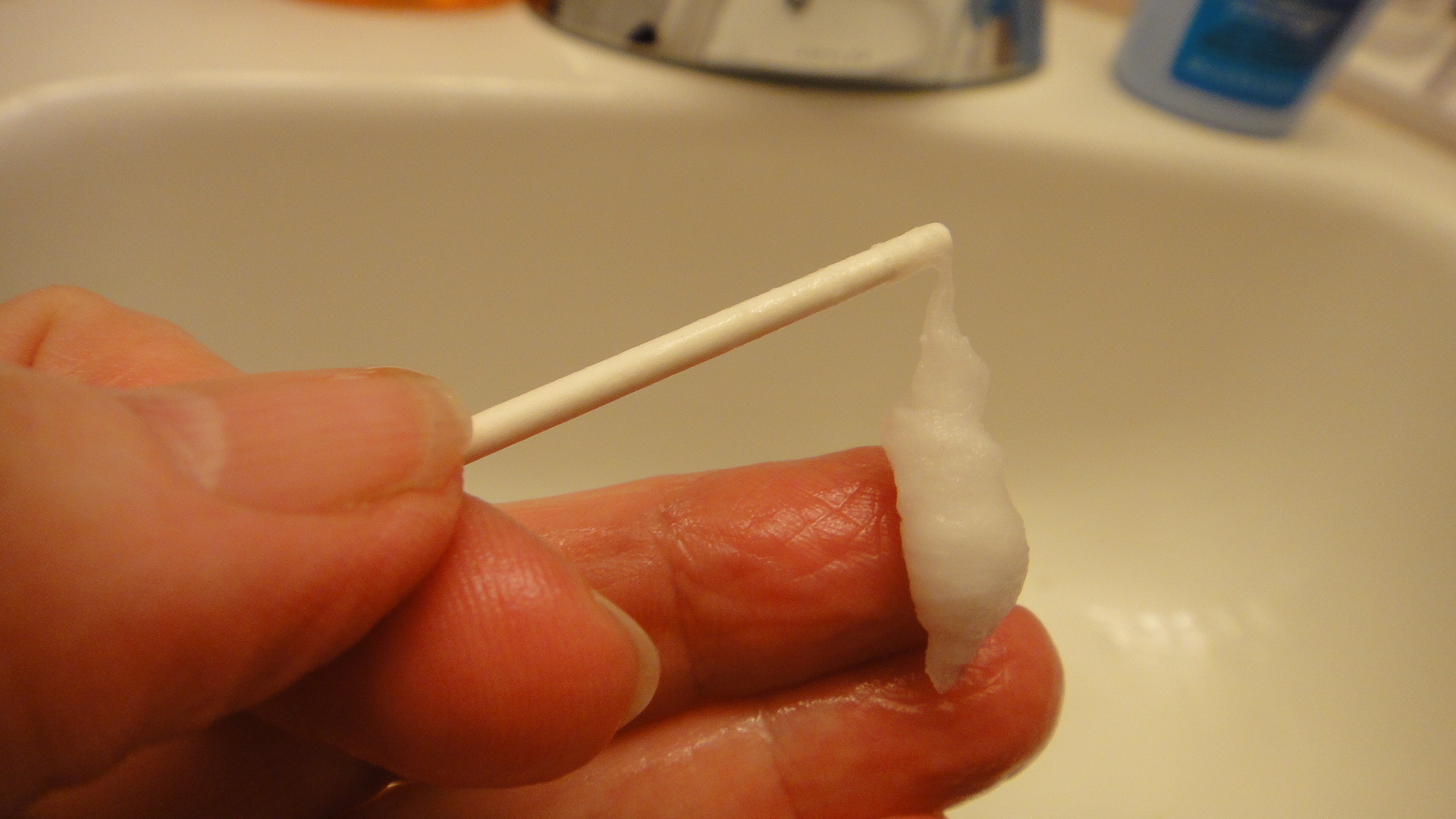
If you are squeamish or the person you share the tube with is in the bathroom at the same time, go ahead and use a Q-tip. Dip it in the toothpaste and wipe it on your brush. Then place the Q-tip in a plastic bag. You can use the other end tomorrow. Do not throw the Q-tip away even after the two uses!

Q-tip method for the squeamish or if you share the toothpaste with someone else and they are watching you.

Once the tube is empty (check the little opening that the toothpaste comes out of!), you can throw it away. I’ve heard reports of people licking the inside and then licking their toothbrush, but who in the world would do a thing like that?


Now you are left with the Q-tips and the plastic bag. Depending on the amount of toothpaste on each Q-tip, you can probably polish at least your large front teeth. Then turn the plastic bag inside out and polish your lower teeth. If necessary, open another tube of toothpaste and squeeze a little on your toothbrush to finish the job.

If you are squeamish, you will have more toothpaste on the plastic bag. I lost my squeams a long time ago and prefer dipping.

Be sure to wash out the plastic bag and use it again! (I shouldn’t have to tell you that.)


For those who are serious about wealth building, you can run the Q-tips under water to remove the cotton. Finding new cotton to wrap around the tip shouldn’t be too hard. A lot of free cotton comes in medicine jars. Dryer lint is also a possibility. I can’t help you with how to attach the cotton or lint. If you are really planning to do that, you need a special kind of help. Make an appointment today.

Warm water removes the used cotton. After that, you're on your own. Even I can't help you.

Now, do the math. Do you see what I mean about saving lots of money? And toothpaste is only the beginning. You can do this with other things that come in tubes: lotions, hemorrhoid cream, and glue. Don’t forget to label the tubes carefully. I’ve heard reports that hemorrhoid cream used on the teeth reduces swelling in gums, but it causes food to slide down your throat before your can chew properly.


If this has been helpful, and I know it has, please take a moment to consider all of the good advice you have received from this blog. As you know, it takes a lot of chocolate to run a blog that is full of so much, shall we say, helpful information. I rely on the generous gifts of dark chocolate from family, friends, and perfect strangers to keep going. Send your chocolate today. Thank you.


In the interest of fairness and the limitations expressly stated on yearstricken’s poetic license, you must be at least ten years old or younger, be responsible for buying your own toothpaste, brush your teeth at least three times a day, and use a lot of toothpaste in order to potentially move into the realm of what yearstricken claims is “lots of money.” Most users of this method can expect to save dozens of dollars over the course of their few remaining years and teeth.

I practice dying every night

Standard

My strength comes in the morning. The early hours wake me at sunrise, smelling of promise and first light. I listen to their bright voices and learn what it means to be born and how to unspool the day from the spinning earth. They carry bird songs in their pockets. Morning is the time for listening. I reach into my heart for crumbs of dreams I’ve carried, toss them at my feet, and wait for the words to land, to eat. Sometimes I hold a word with feathers in my hand and let the tears roll down. It is morning. My strength comes in the morning.


The day is for duty. Small hands point and I must follow. Time schools me, teaches me to climb, move, sit, walk, listen, speak, hurry, wait, and serve. I eat sunlight and grow wings. I cannot fly, but they lighten my load. Duty has a face I love, she never tires, and helps me when I climb. The hours are full of people; we follow time together. Sometimes I rest and wash my feet in their laughter. I give my strength to the day. The day is for duty.


The night is for dying. The words leave me and I watch them rise and go, swallowed by the sky. Sorrow, my sweet sister, whispers in my ear that the time of rest is near. Memories and desires take their leave, sail across the pool of thought till only ripples of their passage remain. I listen to the silence, wrap myself in quiet. The time of letting go has come. My heart steps softly into the dark. I close my eyes, my hands open, releasing every face, dream, and hope I gripped so long, yielding to that other world until I am gone. The night is for dying.


I practice dying every night.


Have you thanked your word surgeon today?

Standard

I just found out from my imagination that today is national Thank a Word Surgeon Day! So I am very excited because as you know, or will know after you finish this sentence, I am a word surgeon. So, thank you, me.

Without word surgeons, no lips would whisper melodies out of flutes, no hand would wield the wild épée, slicing and dicing the villains of the world, and machines would never have the chance to learn to hum. Every flute deserves a kiss from lips, every épée needs to slash out now and then, and all machines deserve to experience the electric thrill of on-ness.


Ever vigilant word surgeons roam the earth searching for nouns, rummaging through old dictionaries, discovering new inventions, reading people’s e-mails, and writing blogs. They are ordinary people who look just like you and me, although I’m pretty sure your mom could tell the difference.


Most of them are kind-hearted people, working late into the night, affixing words that will benefit humankind. One of their favorite suffixes is “-ist.” On discovering the flute, one of them delicately removed the “e,” added the “-ist,” and voilà, the flutist was born. Flutist should not  be confused with flautist, which came later, and was formed by an amateur flaunting his knowledge of Italian. This is where we get the word “flauntist,” which means one who flaunts. Still another professional took the time to add “-ist” to an épée  and Errol Flynn was born, one of the greatest pretend épéeists in the world, who swashbuckled his way into the hearts of millions of moviegoers in the 1930s and 1940s. And finally, I must mention the word surgeon who set the gears of the Industrial Revolution in motion, creating millions of jobs, by having the foresight to drop the “e” and attach “-ist” to a machine.


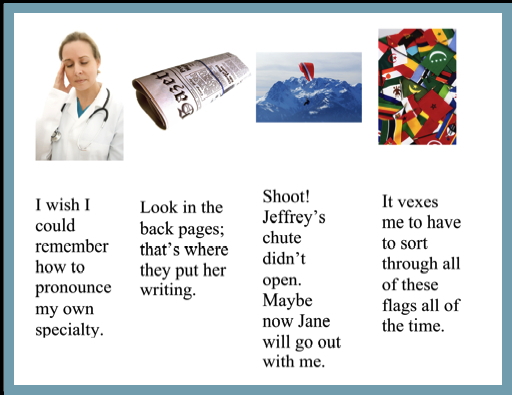
Word surgeons have taken simple nouns and given the world pianists, chemists, and typists. You should be thankful they are not afraid of big words or words that are hard to pronounce. We have them to thank for the otorhinolaryngologist, the feuilletonist, the chutist, and the vexillologist.

However, word surgery is not all fun and games, friends. Bad bananas happen. Sexists, agists, and racists came from somewhere. Don’t blame word surgeons. They don’t take responsibility for bad words, only good words. And if you judge them, they will make bad words about you. It’s what they do: make words.


Because of those bad bananas, “-ist” has been called The Intolerant Suffix by at least one word surgeon I know intimately. And although I fully recognize the dangers, I am going to illustrate how this works. The intolerant part, not the intimate part.  Please understand that the following words are for illustration only and should not be seen as an endorsement or encouragement toward intolerance.

  • Plaid makes you cry – you are a plaidist.
  • Being asked to play another game of Monopoly makes you gag – you are a monopolist.
  • Big hair makes you scream – you are a bouffantist.
  • People who act like donkeys or fools sicken you – you are an assist.
  • Hearing a woman called a “Ho” in a song makes you break things – you are a hoist.
  • Wearing strings instead of panties makes you uncomfortable – you are a thongist.
  • Hearing the f-word all day long makes you want to hit someone – you are a fist.
  • Irons and ironing boards are not allowed in your home – you are an ironist.

Some of you may be tempted to try this at home. I urge you to use caution. Remember, if anything bad comes of it, don’t blame me. However, if anything good comes from it, you can thank me because today is Thank a Word Surgeon Day!