Fear of the dark

Standard

(K) The older, photogenic one

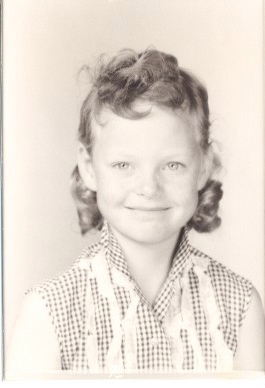
When my father died, I was eight and my sister (K) was ten. Mother’s world collapsed and she found it impossible to function. She stayed in bed under heavy medication for days, until our oldest sister (C) told her she would lose us to daddy’s relatives if she didn’t get up and start living again. Our oldest sister was 23 years old at the time and already a mother of three. We lived a complicated childhood, visiting our oldest sister and her children but hiding it from our father. He wanted nothing to do with mother’s past.

When mother got up out of her bed of despair, she couldn’t get any more medication from the doctor. So she self-medicated. And nothing dulled the pain better than booze.

Together with her best friend from work, mother began to “run the roads.” It’s what she called bar hopping. There’s something lop-sided about this story that no amount of explaining will set right. Mother said that daddy was the one she loved like no other, and yet within two months she was out most nights, drinking, dancing, and looking for love. I don’t try to explain it; I just tell the story as I know it.

During that era, I don’t think it was unusual to leave children our ages alone at home. But maybe at night it was. Mother needed somewhere to go, to find companionship, and to have a few drinks to help her forget. The bars all had a Happy Hour, and although she never found happiness there, at least the drinks were cheap. Rather than leave us at home, she would take us to a theater to let us watch the latest movie, often a horror movie. This provided me with lots of reasons to fear the dark.

Before the years struck me so hard

A few years ago, I was talking with my sister (K) and mentioned all the scary movies we saw when we were kids like The Blob,

The Tingler, The Fly, and House on Haunted Hill. I remember sitting the theater, my feet on the chair tucked under my dress, clutching my sister’s arm, thinking that if I held on tight enough the monster couldn’t get me.

She asked me if I remembered what happened after the movies on those nights mother dropped us off. I told her I didn’t have a single memory of what came before or after.

Have you ever heard someone tell a story about an event that you were part of but that you have absolutely no recollection of? What she told me stunned me.

More than once, after the movie or double feature was over, we waited out in front of the theater long past the last showing. One of those times, we were still there when the lights were shut off and the last person left the building. Then mother would show up smelling of whiskey, cigarette smoke, and sweet perfume. Beautiful, lonely, half-drunk, working hard to forget her pain, and doing such a good job that she forgot her girls out there in the dark, lonely and afraid.

For my sister the horror show started after we left the theater. She was too young to carry so much responsibility, but she had no choice. I clearly couldn’t take care of myself. I think the fear I felt during the long wait in the dark was too real, the sense of abandonment too raw to face, so I transferred it to the movies and thought they were the source of my terror. My sister was the brave one and faced the darkness for both of us. And for all these years, she has had to carry the memories alone. I cannot remember. And that’s one of the reasons I love her.

Much of my childhood I lived under water; the people and events blurred and distorted. Light is refracted when you are below water, so things are recognizable but they don’t line up. I’d come up for air now and then, then dive back under. Some of it I understand; some I don’t. I know one thing: I cannot watch horror movies. They make me afraid of the dark. I know, too, that love is strong and can carry the memories we cannot bear ourselves. But even love feels lonely sometimes.
One chance, one opportunity

Standard

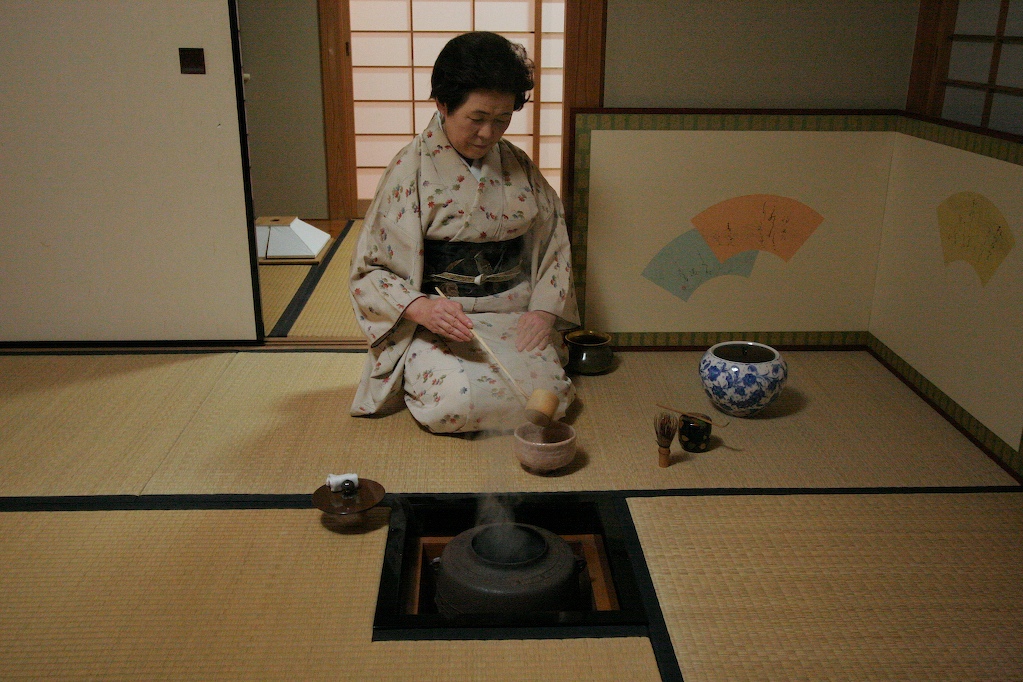
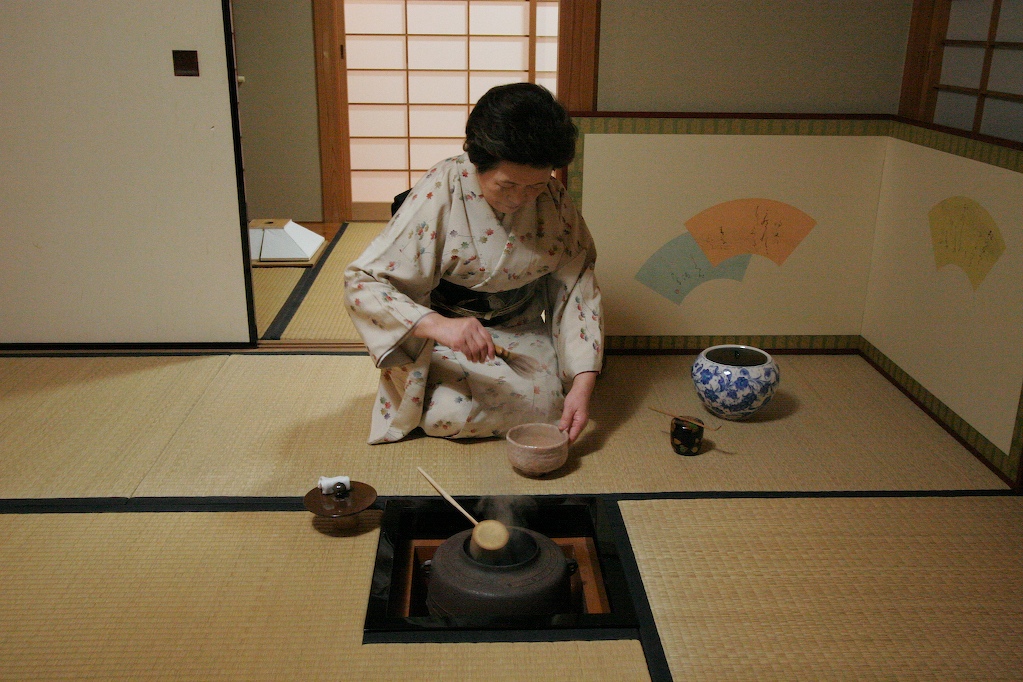
Yesterday I drank a cup of green tea while I did my Japanese calligraphy. The smell of green tea calms me so that I can focus on the ink, the brush, and the strokes. I enjoy it hot or cold, and loved drinking matcha-flavored soy milk or matcha frappacinos when I lived in Japan. Matcha is a kind of powdered green tea that is used in the tea ceremony.

I experienced the tea ceremony only twice. It is a highly ritualized event that gives meaning to the mundane. What could be more prosaic than making and drinking a cup of tea? Yet, in the tea ceremony each and every act is filled with meaning and purpose. The simplest act of stirring the tea, pulling the sleeve of the kimono away, or turning the teacup is noticed and appreciated. For a brief period of time, all that exists is this exquisite act of making and drinking tea.

When else do we make time to marvel at the ability of the body to kneel or enjoy the incredible ability of the wrist to rotate so delicately? During the tea ceremony, this moment, this bending, this pouring, this stirring becomes the sole focus of life. No thought is given to what happened before or what will happen next. What matters is what is happening now.

And it is a communal moment – the shared cup of tea, bitter but lovingly and tenderly made and offered, along with a small sweet. So like life itself. During the ceremony, time is tamed. Tea brings the participants together, and in that moment they belong to the tea and to one another.

Children understand these things so much better than adults. They love rituals. They do something over and over without tiring. The way the page is turned, the voice is modulated, the neck is kissed,  the pillow fluffed, and the last goodnight said – all to be done without variance. And loved for that very reason. The child leads the parent into the ritual – to share the moment, to be together in time, or better, outside of time as the parent usually experiences it. The parent may try to cheat, but the child will rarely allow it, or if the child does, it will be reluctantly and out of obedience or resignation. The moment will be lost.

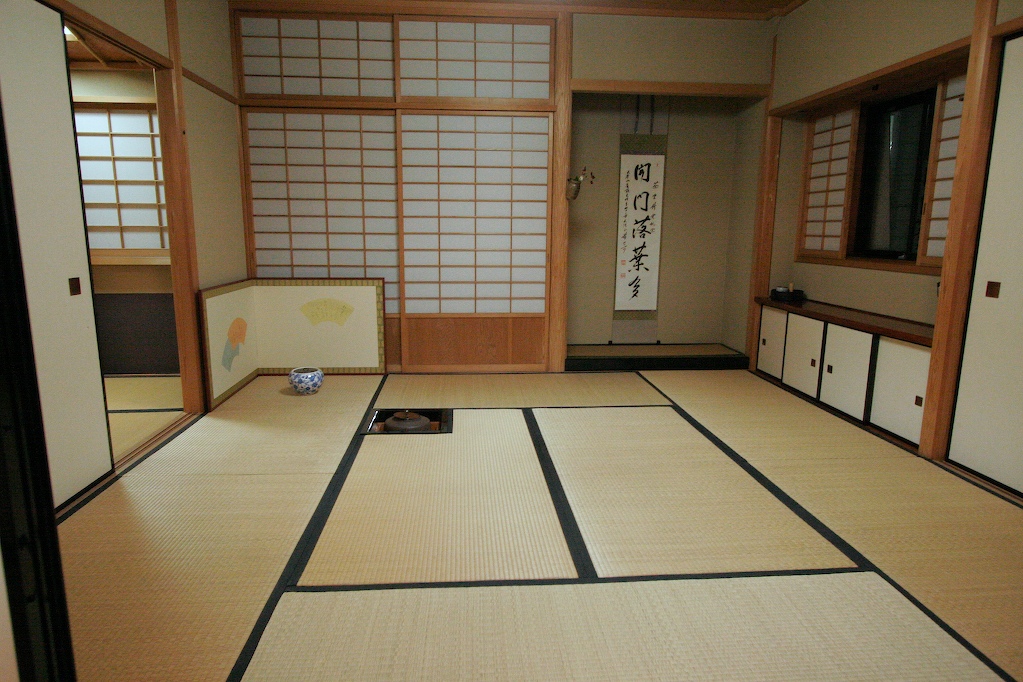
Although I need time to look both backward and forward to understand this path I am on, I don’t want to miss this moment. There is still much I want to see, do, read, and experience, but the tea yesterday reminded me that I also need time to enter the familiar dance of ritual that brings me into the moment and gives meaning to the mundane. One of the phrases associated with the tea ceremony is “ichi go ichi e” ( 一期一会 ), which means one chance, one opportunity. That’s all we get. Now is our only chance to live, to see, to love, and to share. Let’s not lose the opportunity.

The memory of rain

Standard

Dark comes early since we pushed back the tiny hands of time. One hour makes a difference.


The other evening in the early dark, I drove home on rain-lacquered roads. In town, going through a line of traffic signals, the road was a lake of clear water; the red, green, and white lights the fish shimmering and swimming across it.  I thought of my father because rain and I share childhood memories.


When I was growing up, my family went for a ride on rainy nights. Daddy drove and mother sat close beside him. My sister and I sat in the backseat in a cocoon of sounds: the steady swish of wipers trying to keep up with the rain, the shushing sound of tires on the wet roads, and the clicking of our turn signal winking at the other cars to let them know we were turning.


As a family, we watched the rain transform the known world, first with a bright shine, then with a glaze of gray, but always with beauty. In the car, we marveled at the gallery of sights. There was no time or need to tell each other everything we saw in that kaleidoscope of color and shadow – things moved by too quickly.


Above the rain’s murmuring, soft but clear, we heard our parents’  voices. They told stories about us, our relatives, and their own lives. My sister and I listened, awash in the intimacy the rain brought. We learned that our Aunt Ann had been not only a psychiatrist but also a pilot. The rain matched the  faint echo of crying we could hear in those stories about her. Much later we learned she had committed suicide.


They laughed and whispered too. Mother snuggling closer, daddy putting his arm around her. The two of us in the back, following as they took us farther down the road. My sister and I didn’t realize it at the time that we had already begun our own journeys, away from childhood, away from our parents. But on those rainy nights in the car, we were together going in the same direction.


Soon the talk, the dark, and the hum of wheels would lull us to sleep, and my sister and I would lean against our separate doors to dream of catching the brightly colored fish that swam across the rain spattered streets.


Later we would awake to the place of our belonging because, as sure as rain, the road always led us home.


(Picture is from: http://gossipaboutcars.com/)

Thoughts on Writing

Standard

Writing is an exploration of the terrain of truth, and no one can anticipate its discoveries. It is a journey away from home, in search of home. Only those who travel the road know how lonely it can be.

Writing is both disrobing and dissembling. Above all, we seek to be known; and yet, our greatest fear is that people will see us as we really are.

Writing is a compulsion and a conviction entangled with the desire to have a voice that will not be silenced by death.

Writing is a setting out to sea. The sailor cuts loose the ropes and moves some small distance from the harbor, sails unfurled, only to find the winds have died down.

Writing is death. Long and protracted; blood, the only ink. Not writing is death. Quick but painful; the writer a mausoleum full of dead bones.

Writing is throwing stones across the lake. Some skip, some sink, but all cause a change, circle by circle, moving across the waters in the long, slow movement of thought.

Writing is a light that travels out into the darkness long after the flame is snuffed out.

Writing is the echo of the music after the last note is played.

Writing is a terrible struggle for affirmation. The writer is a small child who cries out, “Look at me!  Look at me!”  Sometimes no one looks or looks and says, “That? Anybody can do that, and I can do it better. Look at me!”

Writing is a willingness to lay down the desire for affirmation and serve the call to write. Even if this is foolish.

To All the Real Mothers Out There

Standard

Both of my children are adopted.  Our first-born is now our second child, and our second child is the first-born. It’s okay if you need to re-read the last sentence. When you give birth to children, this kind of thing is impossible; the rules are fixed. With adoption, there are no formulas. Birth order in an adopted family is based on when the child is birthed into your family.

Let me explain. Our youngest was adopted first. The second day after the birth, my husband and I went to the hospital to get our first-born child. The birth mother chose us to be the adoptive parents after viewing a group of portfolios she was given by the adoption agency.  I suppose, for precision’s sake, we could call her the birth-to-the-second-day-mother, which would make me the third-day-on-mother, but I ‘ll talk more about names in a moment.

When we arrived at the obstetrics ward, we met not only the birth mother but her mother and grandmother as well. No one could speak. Our nervous smiles held back the wild joy we felt; their smiles held back a fierce pain. When that young woman placed her baby in my arms, the pronouns all changed, and every one of us began to cry. We stood in a circle, each struck dumb in different ways. Only the social worker could speak, so she offered a prayer.

Normally, even in adoptive families, people do not  upset the chronological birth order, but we did. The first child was three when we adopted the second who was five. Some things are more important than birth order, like love.

We were living in Okinawa, the southernmost prefecture of Japan, when we found out about our second child.  We had to travel  the full length of Japan to an orphanage in Hokkaido, Japan’s northernmost prefecture. We never met the birth mother.

From the beginning, both children knew that they were adopted. We were careful to use the proper terms and explain that they had a birth mother and a birth father, but now we were their mommy and daddy, and we loved them very much.

What are we three mothers involved in these children’s lives to call ourselves? Birth mother fits the other two women, but then what am I, the “after birth mother” (too messy), or the “life mother” (more appropriate for a goddess), or simply “mother” (what I generally use.)

The word that has been raising its hand and waving it wildly in order to get our attention is  that four-letter word, “real,” as in, “Will the real mother, please stand up.”  If by this term we mean the woman who carried the child and gave birth, no small gift, then I am not the real mother. Each of us can have only one of those. The two women who gave life to my children are real mothers who physically sheltered and nurtured them nine months, and then willingly went through the pain of childbirth knowing they would release these beautiful babies to strangers. They were, and are, much more than mere incubators of my joy. Only those who are real can pay such a price.  I love and appreciate these mothers though one I have never met one and the other only once for a few minutes.

It is difficult for our language to accommodate the idea that children can have two real mothers. In the plainest use of  language, it is contradictory. Two parallel lines can never intersect, something we’ve known since Euclid. In an Euclidean grammar, the lines are clearly drawn: there can be only one real mother, and the other must be the birth mother or the adoptive mother, depending on who claims the title of “real.”

There is a geometry besides Euclid’s, however, where these parallel lines do not exist. In elliptical geometry, all lines on a sphere eventually meet. I choose to use a grammar based on that, so I can say without hesitation that there can be two real mothers–the one who gave birth and the one who adopted.

***************

“What is REAL?” asked the Rabbit one day, when they were lying side by side near the nursery fender, before Nana came to tidy the room. “Does it mean having things that buzz inside you and a stick-out handle?”

“Real isn’t how you are made,” said the Skin Horse. “It’s a thing that happens to you. When a child loves you for a long, long time, not just to play with, but REALLY loves you, then you become Real.”

“Does it hurt?” asked the Rabbit.

“Sometimes,” said the Skin Horse, for he was always truthful. “When you are Real you don’t mind being hurt.”

“Does it happen all at once, like being wound up,” he asked, “or bit by bit?”

“It doesn’t happen all at once,” said the Skin Horse. “You become. It takes a long time. That’s why it doesn’t happen often to people who break easily, or have sharp edges, or who have to be carefully kept. Generally, by the time you are Real, most of your hair has been loved off, and your eyes drop out and you get loose in the joints and very shabby. But these things don’t matter at all, because once you are Real you can’t be ugly, except to people who don’t understand.”

“I suppose you are real?” said the Rabbit. And then he wished he had not said it, for he thought the Skin Horse might be sensitive.

But the Skin Horse only smiled.

(from The Velveteen Rabbit)

After Finding a Cure for Breast Cancer, Would Someone Please Answer My Question?

Standard

It’s Breast Cancer Awareness month, and I want to be serious and say something really profound, but in the midst of so much awareness, I keep pondering a question that I feel demands an answer: why do we call them training bras?


I mean, what can you train them to do? When you get them, they already know how to sit up and fetch (in a manner of speaking). But when they grow older, they just lie down and play dead. That’s it. No other tricks, no opposable thumbs, nothing, nada.


But since October is Breast Cancer Awareness Month, I want to be supportive. Or at least say something uplifting. Get things off my chest. Make a couple of points. And yes, I know that I am pun-ishing you. I can’t help it. (And the beauty of the internet is that I can’t hear your groaning.)


Don’t neglect getting your mammogram and check-ups. Early detection gives you a greater chance of beating the cancer. You can read about some of the latest research at the Susan G. Komen for the Cure foundation. The backstory is inspiring: a promise to a dying sister starts a worldwide movement that has touched millions of lives and helped save many of them.


Now I know what I’m going to make my sister promise when I’m on my deathbed. Find out why we call them training bras.

Are You Carrying Secrets?

Standard

As a child, when you first begin to carry secrets, you hold them externally, like a package of eggs, always conscious that you mustn’t drop them. Sometimes you forget that you have them, but if the conversation heads in a certain direction, you panic, check to see that none are cracked, and become once again painfully aware of your charge.

Later you internalize the secrets. If you brood over them too much, they may hatch and breed.

By adulthood, most of the eggs have cracked, been dropped, or lobbed at someone. It can take a lifetime to clean up the mess.

I remember a story on NPR’s “This American Life” about a choice of superpowers, either invisibility or the ability to fly. One woman said emphatically that everyone, if they were honest, would want to be invisible so they could spy on others. She obviously had never been privy to very many secrets. I have heard enough, carried enough, and still carry some that I wish I didn’t have to.

So now I blog. And what are most personal blogs but a whispering of secrets.

Books Will Find You

Standard

My sister and I exchange books. We hang out in used bookstore looking for some author to take home for the night. And we’ve found some great books that way.

Last week, one of my colleagues at work expressed his conflict between wanting to write and finding time to write. A few days later, I lent him Anne Lamott’s book, Bird by Bird. It’s a copy I bought at a used bookstore in Japan several years ago. This colleague had recently purchased a book about sauces and had been reading that. So a small community of three voices was formed: the author who talks about food, Anne who talks about writing, and the man himself. Now, he is writing again, stories based on his conversations with those two authors.

A book is the earliest recording device, a way to preserve a voice, to converse with people in the future. The quill, pen, recording button, or keypad, allows the author’s voice to escape linear time and to live forever in the present. Of course, forever is longer for some authors than others.

Back in Japan, I think Anne was hanging around that bookstore waiting for me. She needed to meet someone new, and so did I. In a very low-tech way, I made a link to her voice by passing along her book.

While we like to think we find books, it’s probably closer to the truth that books find us.

I Wonder Who Planted More Apples, Johnny Appleseed or Steve Jobs

Standard

In 1996, friends in Japan gave us an Apple computer, a first generation PowerBook. It seemed more like a little treasure box than a computer. My only other point of reference was a Wang computer I used for a year at a job. No comparison.


Random thought: I always wanted to work at Wang and answer the phone, “You wang? Sorry, wong number.” Alas, I never had the chance; they went bankrupt.


Anyway, back to that Apple computer. It was love at first click. In fact, I’ve never even looked at a PC, much less flirted with one. (I’m forced to use non-Macs at work, but I always wash my hands when I get home.) At home, we are completely Applefied – computer, phones, and other gadgets. We compute, write, work, surf, and connect on our devices. They’re like a tiny electronic orchard that we tend to, plugging them into the wall for a little “Apple juice” when they get thirsty.


We enjoy them. And part of that enjoyment is their ease and elegance. A perfect blend of beauty and utility.


For that, we can thank Steve Jobs. He spent his career planting Apples around the world, which made a lot of people happy, including us. He will be missed.


You Can Change the World by Looking

Standard

“To look closely at the world is to alter it.” (George Steiner, Real Presences)

How often do you look closely and carefully at the world around you?

Patience and love turn sight into insight. People, nature, and objects reveal themselves slowly. Quiet yourself. Under the long gaze of love, everything is altered.

Including you. How you see the world determines how you act in the world.

What are you waiting for? Start looking.


(photo by seynard)